Impact of Short-Term Hot Water Hand Immersion on Physiological Responses to Different Orthostatic Durations
 , Ayoola Awosika MD, MBA, MS2, Samuel Agaba Ameh MBBS1, John Obogwu MBBS1, Samuel Ijoganu MBBS1, Phoebe Nwamaka Kanikwu PhD3

*Corresponding author: Mayowa Jeremiah Adeniyi, Department of Physiology, Federal University of Health Sciences, Otukpo, Nigeria.
-
Received: ,
Accepted: ,
ABSTRACT
Background and Objective:
The study sought to understand the effect of hot water hand immersion on physiological responses to different orthostatic durations.
Methods:
The study utilized a pre-experimental research design (baseline and post-test). Twenty-one apparently healthy adult male individuals, averaging 19.5 years, who satisfied the inclusion criteria were selected for the study. They were divided into three groups. Each participant did hand immersion in 42°C water for 1 min. Before and after the hot water immersion activity, participants were asked to stand for 5 min (Group I), 10 min (Group II), and 15 min (Group III). Statistical analysis was done using the Statistical Package for the Social Sciences 23, and statistical significance was accepted at P < 0.05.
Results:
The results of the study indicated that as orthostatic durations increased, systolic and diastolic blood pressure, pulse rate, and rate-pressure product increased, and SpO2 decreased. When compared with hot water-exposed participants who underwent orthostasis for 5 min, there was significant reduction in systolic and diastolic blood pressure, pulse rate, rate-pressure product, and shock index in hot water-exposed participants who stood for 15 min. Furthermore, peripheral oxygen saturation was peak in hot water-exposed participants who stood for 15 min.
Conclusion and Implications for Translation:
The findings of the study indicated the beneficial modulatory roles of brief hot water hand immersion on physiological responses to prolonged orthostasis in adult males. Brief hot water hand immersion may activate the sympathetic response, leading to improvement in orthostatic tolerance. Orthostatic intolerance is a cardinal public health concern due to its relationship with cardiovascular diseases and mortality. Patients with orthostatic hypotension may benefit from a brief topical thermotherapy.
Keywords
Hot Water Immersion
Orthostatic Durations
Peripheral Oxygen Saturation
Pulse Rate
Systolic and Diastolic Pressure
INTRODUCTION
Adult human beings are favorably destined to adjust and maintain a fairly stable body temperature irrespective of changes in ambient temperature.[1] Over time, concerns have begun to grow about changes in climate and their attendant impacts on human health. A study conducted by Ayeni and Oloukoi, (2022)[2] in Akure, Nigeria, on the trend of ambient temperature showed an increase above normal by 1°C at the end of 2000 and 1.6°C at the end of 2022. According to data obtained from the Nigeria Meteorological Agency, there was a continuous increase in extreme heat in Yobe, North-East Nigeria, between 2009 and 2020.[3] Besides, there is increasing evidence that heat intensity may soar in the future.[2] Changing ambient heat has pound influences on body functions. In a self-reported study, warmer temperatures were recorded during day and night with attendant health impacts including heat exhaustion, sleep disturbance, sweating, and dehydration.[4]
A hot bath at 40°C has been extensively reported to suppress spermatogenesis and reduce sperm count in healthy males.[1,5] Immersion of chronic heart failure patients in a hot spring at 40°C for a period of 10 min for 14 days led to a reduction in alpha-tumor necrosis factor, interleukin-6, high-sensitive C-reactive protein, and improvement in brain natriuretic peptide and ejection fraction.[6] In a study by Rodrigues et al., (2020),[7] hot water immersion at 42°C to the waist region was shown to increase vastus lateralis temperature without differences between male and female participants. Hot spring bath (containing chloride, bicarbonate, and sulfate types) for a period of 1 week was reported to cause an increase in the relative abundance of gut microbiota Bifidobacterium bifidum in fecal samples.[8]
In the cardiovascular system, 10 min after healthy males had undergone a warm bath (at 40°C) for 60 min, there was a rise in pulse rate and systolic blood pressure and a decline in mean arterial blood pressure when compared to those who underwent a thermoneutral bath (at 34°C).[9] In 873 Japanese subjects, a hot bath for more than 5 times/week led to a reduction in brachial ankle pulse wave velocity, brain natriuretic peptide, and central pulse pressure, with bathing frequency correlating negatively with brain natriuretic peptide and pulse pressure (Kohara et al., 2018).[10] In 61 participants, Barry et al., (2024)[11] observed that at ambient heat induced core temperature rise of 1.5°C, mean blood flow increased in healthy young adults at change of 0.8 mL/min/g and in healthy older and older adults with coronary artery diseases at 0.7 mL/min/g and 0.6 mL/min/g, respectively. When six healthy male individuals were immersed in circulating hot water for a period of 21 min at different intervals, heart rate, sweat rate, and body temperatures were found to be elevated in those who underwent a 41°C bath when compared to those who underwent a 40°C bath.[12]
Besides diversion of 0.75 L of blood to the extremities during standing,[1,13] sudden switch to the standing position caused decreased alpha wave frequency and alpha/beta ratio.[14] Prolonged unipedal orthostasis results in an increase in alpha wave frequency and alpha/beta ratio.[15] Post-exercise orthostasis was associated with lower theta wave amplitude in males when compared to females.[14,16] Previous works have documented the roles of water in improving orthostatic tolerance. A study by Claydon et al., (2006)[17] revealed that ingestion of 500 mL of water assuaged orthostasis-induced suppression in venous return and increased peripheral resistance and blood pressure. Schroeder et al., (2002)[18] also indicated that consumption of 500 mL of water improved orthostatic tolerance by about 5 min. The aim of the study was to determine the effect of hot water hand immersion on physiological responses to different orthostatic durations.
METHODS
The study utilized a pre-experimental research design (baseline and post-test).
Study Design
The research was carried out in the Department of Physiology, College of Medicine, Federal University of Health Sciences, Otukpo, situated in Otukpo Local Government Area of Benue State, Nigeria.
Participants
Thirty young individuals were recruited for the study through respondent driven sampling. Twenty-one healthy young adult males who satisfy the inclusion criteria were selected. The average age of the participants was 19.5 years. Written consent was gotten from each participant.
Inclusion Criteria
Male participants were recruited for the study. Blood pressure, pulse rate, and respiratory rate were assessed. Participants whose systolic blood pressure and diastolic blood pressure, pulse rate, and respiratory rate range from 90 mmHg–120 mmHg, 60 mmHg–80 mmHg, 60 BPM–100 BPM, and 12 cycles/min–20 cycles/min, respectively, were accommodated.
Exclusion Criteria
A well-structured questionnaire was administered to rule out those with a medical history of alcohol, smoking, and caffeine, and any form of medication, kidney, hepatic, and metabolic diseases, as previously reported.[19-22] Participants with history of respiratory and cardiovascular diseases and those with anatomical deformities were not accommodated.
Study Procedure
The 21 participants were equally divided into three groups. Group I: Before the start of the study, pulse rate, blood pressure, and peripheral oxygen saturation were measured and recorded in a reclining sitting position after 5 min of rest. Participants were then requested to stand from sitting position for 5 min; pulse rate, blood pressure, and peripheral oxygen saturation were measured and recorded. After 30 min interval, they were requested to dip their right hands in a hot water (42°C) for 1 min; pulse rate, blood pressure, and peripheral oxygen saturation were recorded. After 30 min interval, they were requested to immerse their right hands in a hot water (42°C) for 1 min immediately after which they stood for 5 min. Final readings of pulse rate, blood pressure, and peripheral oxygen saturation were taken.
Group II: Before the start of the study, pulse rate, blood pressure, and peripheral oxygen saturation were measured and recorded in a reclining sitting position after 5 min of rest. Participants were then requested to stand from sitting position for 10 min; pulse rate, blood pressure, and peripheral oxygen saturation were measured and recorded. After 30 min interval, they were requested to dip their right hands in a hot water (42°C) for 1 min; pulse rate, blood pressure, and peripheral oxygen saturation were recorded. After 30 min interval, they were requested to immerse their right hands in a hot water (42°C) for 1 min, immediately after which they stood for 10 min from a sitting position. Final readings of pulse rate, blood pressure, and peripheral oxygen saturation were taken.
Group III: Before the start of the study, pulse rate, blood pressure, and peripheral oxygen saturation were measured and recorded in a reclining sitting position after 5 min of rest. Participants were then requested to stand from sitting position for 15 min; pulse rate, blood pressure, and peripheral oxygen saturation were measured and recorded. After 30 min interval, they were requested to dip their right hands in a hot water (42°C) for 1 min; pulse rate, blood pressure, and peripheral oxygen saturation were recorded. After 30 min interval, they were requested to immerse their right hands in a hot water (42°C) for 1 min, immediately after which they stood for 15 min from a sitting position. Final readings of pulse rate, blood pressure, and peripheral oxygen saturation were taken.
Measurement of Blood Pressure and Pulse Rate
Blood pressure was measured from the arm, an inch above the elbow, using a Mercurial Sphygmomanometer (Kris Aloy, Shanghai SNWI Medical CO., LTD.).[23-25] Pulse rate wasdetermined as the number of arterial pulsations in 1 min. Baseline readings were taken at sitting position attached.
Pulse pressure was determined by subtracting diastolic blood pressure from systolic blood pressure. In addition to the pulse pressure, mean arterial blood pressure was calculated. Mean arterial blood pressure was obtained using diastolic blood pressure +1/3 of pulse pressure.
Shock index was determined by dividing pulse rate by systolic blood pressure (pulse rate/systolic blood pressure).
Rate-pressure product was determined by product of systolic blood pressure and pulse rate.
Statistical analysis
Statistical analysis was conducted using the Statistical Package for the Social Science Students 23 as previously reported.[25] Statistical test was done using Analysis of Variance and correlational analysis was done using Pearson correlation. Statistically significant difference was accepted at P < 0.05.
RESULTS
Short-term Hot Water Hand Immersion and Shock Index
Figure 1 shows effect of short-term hot water hand immersion on shock index during different orthostatic durations. Warm water hand immersion before 15 min orthostasis reduced shock index when compared to hot water-exposed participants that underwent orthostasis for 5 min.
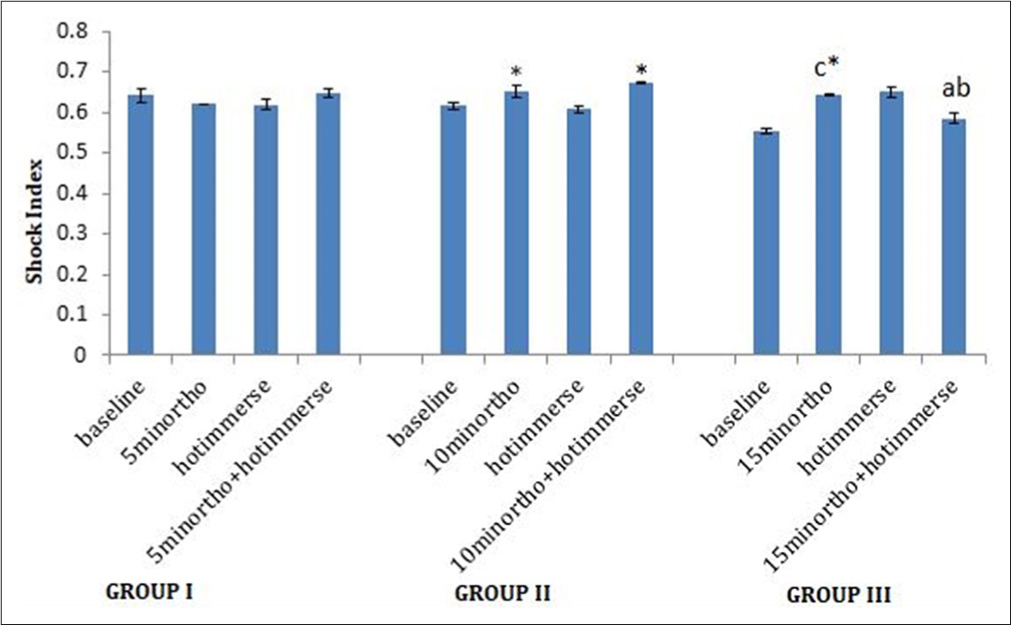
- Effect of short term hot water hand immersion on shock index during different orthostatic durations. ‘*’ represents significant difference from the baseline. ‘a’ represents significant difference from 5minortho+hotimmerse; ‘b’ represents significant difference from 10 minortho + hotimmerse; ‘c’ represents significant difference from 5minortho.
Short-term Hot Water Hand Immersion and Rate-Pressure Product
Figure 2 shows effect of short-term hot water hand immersion on rate-pressure product during different orthostatic durations. The rate-pressure product was significantly elevated during 10 and 15 min of orthostasis, respectively, when compared to 5 min orthostatic duration. Warm water hand immersion before 15 min orthostasis reduced the rate-pressure product when compared to hot water-exposed participants who underwent orthostasis for 5 min and 10 min, respectively.
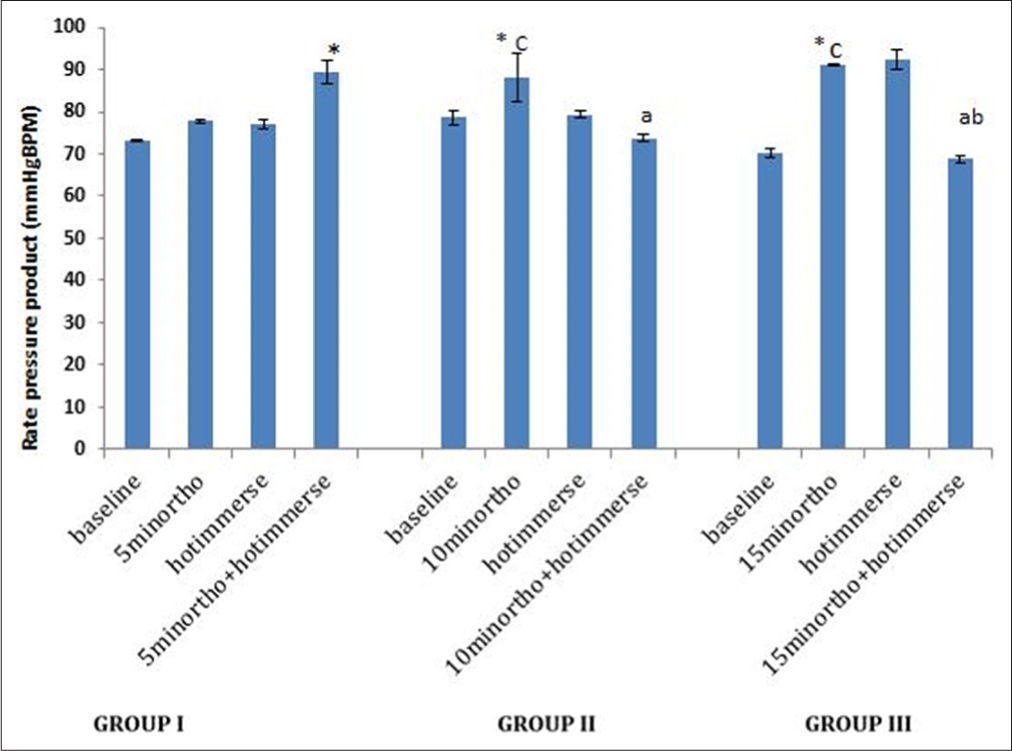
- Effect of short term hot water hand immersion on rate pressure product during different orthostatic durations. ‘*’ represents significant difference from the baseline. ‘a’ represents significant difference from 5minortho+hotimmerse; ‘b’ represents significant difference from 10 minortho + hotimmerse; ‘c’ represents significant difference from 5minortho.
Short-term Hot Water Hand Immersion and Cardiovascular Parameters
Table 1 shows effect of short-term hot water hand immersion on cardiovascular parameters during different orthostatic durations. Systolic blood pressure, mean arterial blood pressure, and pulse rate were significantly elevated during 10 and 15 min of orthostasis, respectively, when compared to 5 min orthostatic duration. Warm water hand immersion before 15 min orthostasis reduced the systolic blood pressure, mean arterial blood pressure, and pulse rate when compared to hot water-exposed participants that underwent orthostasis for 5 min and 10 min, respectively.
Diastolic blood pressure was significantly elevated during 10 min of orthostasis when compared to 5 min orthostatic duration. Warm water hand immersion before 15 min orthostasis reduced the diastolic blood pressure when compared to hot water-exposed participants who underwent orthostasis for 5 min and 10 min, respectively. However, warm water hand immersion before 15 min orthostasis caused a significant increase in diastolic blood pressure when compared to exposed participants who underwent orthostasis for 10 min.
Pulse pressure was significantly elevated during 10 min of orthostasis when compared to 5 min orthostatic duration. Warm water hand immersion before 15 min orthostasis reduced the pulse pressure when compared to hot water-exposed participants who underwent orthostasis for 5 min.
Short-term Hot Water Hand Immersion and Peripheral Oxygen Saturation
Figure 3 shows the effect of short-term hot water hand immersion on peripheral oxygen saturation during different orthostatic durations. Peripheral oxygen saturation was significantly elevated during 10 and 15 min of orthostasis, respectively, when compared to 5 min orthostatic duration.
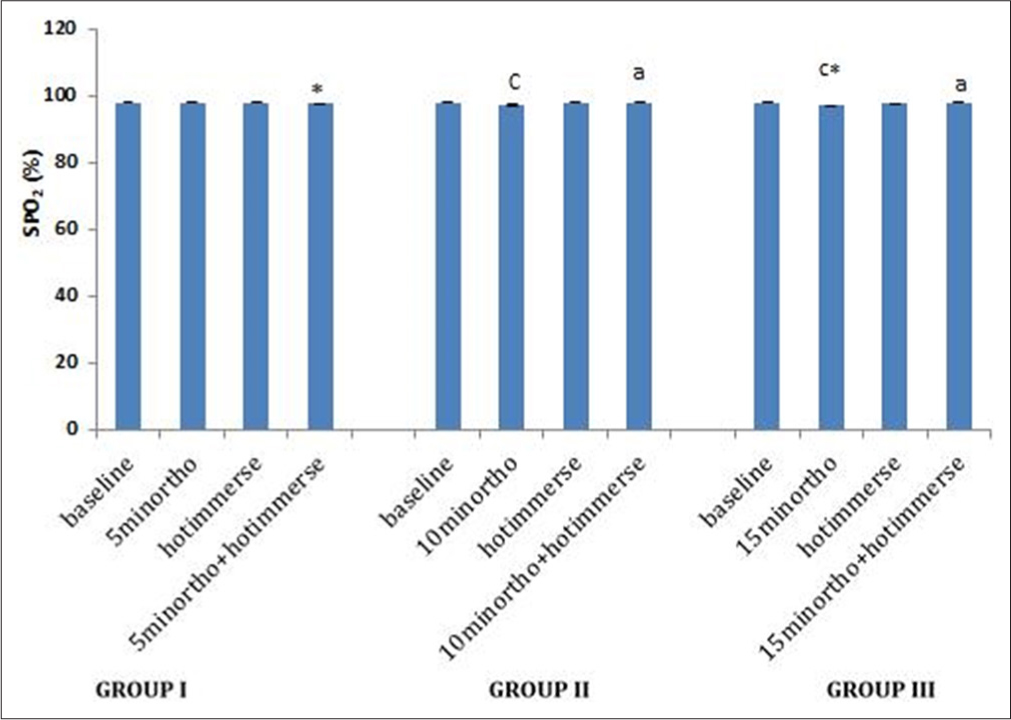
- Effect of short term hot water hand immersion on peripheral oxygen saturations during different orthostatic durations. ‘*’ represents significant difference from the baseline. ‘a’ represents significant difference from 5minortho+hotimmerse; ‘b’ represents significant difference from 10 minortho + hotimmerse; ‘c’ represents significant difference from 5minortho.
DISCUSSION
Rising ambient heat production is one of the major environmental challenges bedeviling the world today, with developing and underdeveloped countries at a relatively higher disadvantage.[2] Generation of ambient heat occurs through the sun and other natural processes, as well as through industrial and human activities.[26] The importance of water ingestion before and during physical exertion and orthostatic stress has been reported.[17-19,27,28] The study investigated the effect of hot water hand immersion on physiological responses to different orthostatic durations.
It was apparent from the study that shock index, pulse rate, systolic blood pressure, diastolic blood pressure, pulse pressure, and rate-pressure product increased as orthostatic durations increased, especially at 15 min. Worthy of note was the rise in pulse pressure and diastolic blood pressure during 15 min orthostasis when compared with 10 min orthostasis. Orthostatic tolerance is an adaptation of bipedal organisms to gravitational stress and it requires sensitive neurovascular reflex mechanisms. Usually, reduction in central blood volume and blood volume is associated with the inactivation of the baroreflex with attendant increase in sympathetic dominance.[29]
Among the effects of sympathetic discharge to peripheral arterial vascular and cardiac muscles are increased peripheral vascular resistance, increased diastolic blood pressure and systolic blood pressure, and rapid heart rate.[1,22,25,30] An advantage of increased peripheral resistance during prolonged standing is a reduction in the likelihood of venous pooling in the lower extremities. Besides baroreflex activation, prolonged standing-induced blood volume reduction is a potent activator of the renin-angiotensin-aldosterone system. Rennin angiotensin aldosterone system activation is associated with salt and water retention, increased plasma volume, cardiac output and rise in blood pressure.
Peripheral oxygen saturation shows the amount of oxygenated blood that reaches the peripheral tissues through the blood. Therefore, factors such as cardiac output and capillary densities play important roles in determining peripheral oxygen saturation.[25] The decline in peripheral oxygen saturation after 10 min and 15 min of standing might be due to peripheral vasoconstriction designed to reduce venous pooling. The major finding of the study was a reduction in shock index, pulse rate, systolic blood pressure, diastolic blood pressure, pulse pressure, and rate- pressure product, and an increase in peripheral oxygen saturation in hot water-exposed individuals who underwent 15 min orthostasis when compared to hot water-exposed individuals who underwent orthostasis for 5 min. This occurred despite the fact that brief hot hand immersion did not cause reduction but increase in diastolic blood pressure, systolic blood pressure, pulse pressure, double product, and rate-pressure product. Interestingly, this is not the first study that showed that brief hot water hand immersion caused increase in pulse rate, systolic blood pressure, diastolic blood pressure, pulse pressure, and rate-pressure product. A study by Miwa et al., (1994)[9] also revealed that warm bath (at 40°C) for 60 min orchestrated a rise in pulse rate and systolic blood pressure. However, no similar study has reported the impact off short-term hot water hand immersion on orthostatic challenge. How hot water immersion during 15 min orthostasis led to reduction in shock index, pulse rate, systolic blood pressure, diastolic blood pressure, pulse pressure, and rate-pressure product, and an increase in peripheral oxygen saturation is not very clear. It is possible that prolonged orthostasis-induced sympathetic activation and vasoconstriction elicits a vascular response which is similar to frostbite-related intermittent vasodilation[31] might have been developed. Perhaps, this response was mediated by local increase in metabolic products including heat. Further studies are required to clarify the assumption.
| Group I (MEAN±SEM) | ||||
| Baseline | 5 Minortho | Hotimmerse | 5 Minortho+ Hotimmerse | |
| SBP (mmHg) | 107±1.27107 | 112±0.32* | 111.5±0.47* | 117.5±0.79* |
| DBP (mmHg) | 70±0.63 | 73±0.32* | 73±0.32* | 77±0.32* |
| MABP (mmHg) | 82.3±0.84 | 86±0.32* | 85.8±0.37* | 90.5±0.57* |
| Pulse rate (BPM) | 68.5±1.11 | 69.5±0.16 | 69±1.27 | 76±1.9* |
| Pulse Pressure (mmHg) | 37±0.63 | 39±0.00* | 38.5±0.16* | 40.5±0.7* |
| Group II (MEAN±SEM) | ||||
| Baseline | 10 Minortho | Hotimmerse | 10 Minortho+ hotimmerse | |
| SBP (mmHg) | 113±1.98 | 116±2.47c | 114.3±1.49 | 104.7±0.66a |
| DBP (mmHg) | 73.7±1.32 | 76.3±1.5*c | 74.6±1.01 | 68±0.55* |
| MABP (mmHg) | 86.8±1.54 | 89.6±1.86*c | 87.9±1.18 | 80.2±0.58*a |
| Pulse rate (BPM) | 69.5±0.16 | 75.7±3.38*c | 69.3±0.18 | 70.5±0.47a |
| Pulse Pressure (mmHg) | 39.3±0.66 | 39.7±0.92 | 39.7±0.48 | 36.7±0.18* |
| Group III (MEAN±SEM) | ||||
| Baseline | 15 Minortho | Hotimmerse | 15 Minortho+Hotimmerse | |
| SBP (mmHg) | 112.5±0.16 | 119±0.00*c | 119±0.00 | 108.5±0.47ab |
| DBP (mmHg) | 72.5±0.16 | 78.5±0.16*cd | 78.5±0.16 | 71±0.63ab |
| MABP (mmHg) | 85.8±0.05 | 92±0.11*c | 92±0.21 | 83.5±0.58ab |
| Pulse rate (BPM) | 62.5±0.79 | 76.5±0.16*c | 77.5±1.74 | 63.5±1.10ab |
| Pulse Pressure (mmHg) | 40±0.32 | 40.5±0.16cd | 40.5±0.16 | 37.5±0.16*a |
‘*’ represents significant difference from the baseline.
‘a’ represents significant difference from 5 minortho+hotimmerse;
‘b’ represents significant difference from 10 minortho+hotimmerse;
‘c’ represents significant difference from 5 minortho;
’d’ represents significant difference from 10 minortho, SEM: Standard Error of Mean
CONCLUSION AND IMPLICATIONS FOR TRANSLATION
The findings of the study suggested that brief hot water hand immersion elicited a beneficial modulatory influence during prolonged orthostatic duration in male adult individuals. As a significant public concern, patients with orthostatic hypotension may benefit from a brief topical thermotherapy. Future studies are needed to clarify the impact of brief hot water hand immersion on physiological responses to in patients with orthostatic tachycardia.
Key Messages
(1) As orthostatic durations increased, shock index, rate-pressure product, systolic and diastolic blood pressure, pulse rate, and rate-pressure product increased and SpO2 decreased.
(2) Brief hot water hand immersion may activate the sympathetic response, leading to improvement in orthostatic tolerance. (3) Patients with orthostatic hypotension may benefit from a brief topical thermotherapy.
Acknowledgment:
The authors are grateful to laboratory staff of the physiology department for their technical supports.
COMPLIANCE WITH ETHICAL STANDARDS
Conflicts of Interest: The authors declare no conflicts of interest. Financial Disclosure: Not applicable. Funding/ Support: Not applicable. Ethics Approval: Written consents and approval (FUHSO/AO91) received for the study. Declaration of Patient Consent: Patient’s consent was not required as there are no patients in this study. Apparently healthy participants were recruited for the study. Use of Artificial Intelligence (AI)-Assisted Technology for Manuscript Preparation: There was no use of artificial intelligence (AI)-assisted technology for assisting in the writing or editing of the manuscript and no images were manipulated using AI. Disclaimer: None.
REFERENCES
- Human cardiovascular responses to a 60-min bath at 40 degrees C.Environ Med. 1994;38(1):77-80.
- [Google Scholar]
- Habitual hot water bathing protects cardiovascular function in middle-aged to elderly Japanese subjects.Sci Rep. 2018
Jun 21 ;8(1):8687.- [CrossRef] [PubMed] [Google Scholar]
- The effect of heat exposure on myocardial blood flow and cardiovascular function.Ann Intern Med. 2024
Jul ;177(7):901-10.- [CrossRef] [PubMed] [Google Scholar]
- Water drinking acutely improves orthostatic tolerance in healthy subjects.Circulation. 2002
Nov 26 ;106(22):2806-11.- [CrossRef] [PubMed] [Google Scholar]
- Impact of night study frequency on sleep pattern, anthropometrical indices and peripheral oxygen saturation in age-matched Nigerian female students prior to semester examination.Int J Biomed Sci. 2020;16(3):37-42.
- [CrossRef] [Google Scholar]
- Changes in body temperature and intestinal antioxidant enzymes in healthy and colitis male rats: Role of garciniakola.Int J Physiol. 2016;4(2):36-41.
- [CrossRef] [Google Scholar]
- Impacts of environmental stressors on autonomic nervous system. Aslanidis T, Nouris C, editor. Autonomic nervous system - special interest topics. London: IntechOpen; 2022.
- [CrossRef] [Google Scholar]