
Factors Associated with Alcohol Consumption Among Students in High-Cost Schools in Lusaka, Zambia
DOI:
https://doi.org/10.21106/ijtmrph.69Keywords:
- Adolescent Alcohol Consumption,
- Attitude Towards Alcohol,
- Parental Monitoring,
- Parental Alcohol Use,
- Pocket Money
Abstract
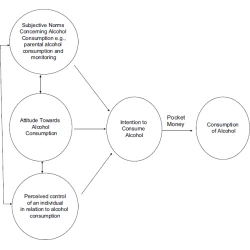
Introduction: The prevalence of alcohol consumption among adolescents is very high in Zambia, in spite of the knowledge on the negative effects of alcohol consumption on adolescents. The objective of this study was to determine factors associated with alcohol consumption among secondary school students in high-cost public schools. Methods: A cross-sectional study of 357 students in Grades 8 and 11 was conducted. Data were collected using structured questionnaires. The associations and correlations between explanatory variables and the outcome of interest was established using Chi-square or the Fisher’s exact test. Magnitudes of association were estimated using Odds ratio. Results: The prevalence of alcohol consumption among the students was 43.7%. Factors predictive of students’ alcohol use were attitude towards alcohol consumption (Adjusted Odds Ratio (AOR) =3.15, 95% Confidence Interval (CI) [1.04,9.56]), parental monitoring (AOR=0.69, 95% C.I. [0.69, 0.94]), parental alcohol use (AOR= 1.76, 95% C.I. [1.39,2.23]) and pocket money availability (AOR= 1.52, 95% C.I. [1.03,2.26]). The prevalence of alcohol consumption was high. Students with positive attitudes towards alcohol consumption were found to be 3.15 times more likely to drink alcohol compared to students with negative attitudes. Students who are highly monitored by their parents were found to be 31% less likely to drink alcohol compared to those rarely monitored by their parents. Students whose parents drink alcohol were found to be 76% more likely to drink alcohol compared to those whose parents do not drink alcohol. Students with a high amount of pocket money were found to be 52% more likely to drink alcohol compared to those without pocket money. Conclusion and Implication for Translation: Results indicate a high prevalence of alcohol consumption among secondary school students of high-cost schools. Potential interventions should focus on inclining the students’ attitudes against alcohol consumption, encouraging increased parental monitoring, and teaching students how to use their pocket money more appropriately.
Downloads
Most read articles by the same author(s)
- Nsofwa Jubedah Mwansa, Victor Daka, David Mulenga, Ruth L Mfune, Bright Mukanga, Christopher Nyirenda, Seter Siziya, Correlates of Seizure Control Among Patients with Epilepsy at Two Referral Hospitals in Zambia , International Journal of Translational Medical Research and Public Health: Vol. 4 No. 2 (2020): The International Journal of Translational Medical Research and Public Health (IJTMRPH)
Similar Articles
- Valerie Luzi, The U.S. Opioid Crisis: Decriminalization as a Potential Approach , Vol. 4 No. 1 (2020): The International Journal of Translational Medical Research and Public Health (IJTMRPH)
- Ashok Bahadur Varma, Can the Internal Nasal Valves Method Be a Game Changer for Preventing Respiratory Tract Infections? , Vol. 8 No. Continuous (2024): The International Journal of Translational Medical Research and Public Health (IJTMRPH)
- Hyunjung Lee, Gopal K Singh, Racial and Ethnic Disparities in the Mental Health Impact of the COVID-19 Pandemic in the United States: Analysis of 3 Million Americans from the National Health Interview Survey and Household Pulse Survey , Vol. 6 No. 2 (2022): The International Journal of Translational Medical Research and Public Health (IJTMRPH)
- Gopal K Singh, Hyunjung Lee, Marked Disparities in COVID-19 Prevalence by Racial/Ethnic, Socioeconomic, Geographic, and Health Care Characteristics, United States, January – April, 2021 , Vol. 5 No. 2 (2021): The International Journal of Translational Medical Research and Public Health (IJTMRPH)
- Gopal K Singh, Hyunjung Lee, Romuladus E Azuine, Increasing Trends in Physical and Mental Health Problems among US Workers in Different Job Sectors During the COVID-19 Pandemic , Vol. 5 No. 2 (2021): The International Journal of Translational Medical Research and Public Health (IJTMRPH)
- Hamisu M. Salihu, Aisha A. Abdullahi, Hassan A. Murtala, Amina Aminu, Muhammad A. Abbas, Abubakar L. Yusuf, Muktar H. Aliyu, Sani H. Aliyu, Ololade D. Adeyemi, Deepa Dongarwar, Jordi B. Torrelles, Gambo Aliyu, Predictors of Human Immunodeficiency Virus (HIV) Acquisition among Children 0–14 Years in Nigeria , Vol. 9 No. Continuous (2025): The International Journal of Translational Medical Research and Public Health (IJTMRPH)
- Amina A. Umar, Yusuf D. Jobbi, Hassan Adam Murtala, Aisha Adam Abdullahi, Muktar H. Aliyu, Sani H. Aliyu, Eknath Naik, Ololade D. Adeyemi, Deepa Dongarwar, Hamisu M. Salihu, Socioeconomic and Clinical Determinants of Nutritional Phenotypes among Children with Sickle Cell Disease , Vol. 9 No. Continuous (2025): The International Journal of Translational Medical Research and Public Health (IJTMRPH)
- Angelique B Willis, Mildred Addo, Lauren E Yoder, Cassandra K Johnson, Sydney L Resler, Leticia J Young, Elizabeth Armstrong-Mensah, Individual and Community Level Factors Related to Sanitation, Water Quality, Treatment and Management in Rural Communities in Accra, Ghana: A Field Study Report , Vol. 6 No. 1 (2022): The International Journal of Translational Medical Research and Public Health (IJTMRPH)
- Shivam Singh, Ashok Sharma, Richa Tripathi, Vitthal Govindappa Huddar, Subhash Gupta, Network Pharmacology and Preliminary in Vitro Evaluation of Piper longum (Indian Long Pepper) in Breast Cancer , Vol. 10 (2026): The International Journal of Translational Medical Research and Public Health (IJTMRPH)
- Nareesa Karmali, Kanisha Blake, Brownmagnus Olivers, Sussan E Ekejiuba, Romuladus E Azuine, The Effect of Maternal Vitamin D Status on Fetal Growth and Stunting: A Systematic Review , Vol. 5 No. 2 (2021): The International Journal of Translational Medical Research and Public Health (IJTMRPH)
You may also start an advanced similarity search for this article.
Published
How to Cite
Issue
Section
License
Copyright © 2019 Chongo Clays Siwale, Seter Siziya. Published by Global Health and Education Projects, Inc., USA.

This is an open-access article distributed under the terms of the Creative Commons Attribution-NonCommercial-ShareAlike 4.0 International License , which permits others to remix, transform, and build upon the work non-commercially, provided the original author is credited and the new creations are licensed under the same terms.



 .
.

