
Polio Eradication in Nigeria and India: A Systematic Review of Challenges and Successes
DOI:
https://doi.org/10.21106/ijtmrph.92Keywords:
- Polio,
- Immunization,
- Nigeria,
- India,
- Pakistan,
- Eradication,
- Systematic Review
Abstract
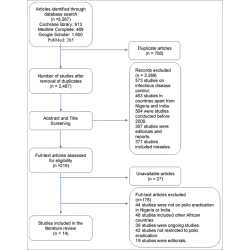
Background: The global eradication of polio is considered an emergency and an unaccomplished task until completely eliminated. Vaccinating children against the polio virus confers immunity on them and breaks the transmission of the polio virus. Afghanistan, Nigeria and Pakistan remain the only three countries in the world that have not eliminated polio. The aims of this paper were to: (1) to identify the factors that impact the failure to eliminate polio from Nigeria and (2) determine the factors that led to the successful elimination of polio from India. Methods: A systematic literature review was carried out to meet the above research objectives. Four electronic databases were searched (Cochrane Library, Medline, PubMed and Google Scholar) and articles that fulfilled the inclusion and exclusion criteria were selected and critically appraised. Results: In all, 98 articles were retrieved. After selection based on our selection criteria, fourteen studies were identified and included in the study. These were 5 systematic reviews: 3 cross-sectional studies, 3 mixed methods studies, 2 case-control studies and one quantitative (survey) study. In all, seven themes were identified from the review of the articles. Four themes were identified from the factors associated with the failure to eliminate polio from Nigeria: (1) Failure of the oral polio vaccine (OPV); (2) Institutional and geographical failures in vaccine programs; (3) Program and campaign management limitations; and (4) Vaccine refusal. Similarly, three themes were identified from the factors that contributed to the elimination of polio from India: (1) Replacement of the trivalent OPV with the monovalent and bivalent OPVs; (2) Implementation of intensive social mobilization strategies; and (3) Effective program micro planning and campaign management. Conclusion and Implications for Translation: Based on the findings from the literature review, we highlight areas where Nigeria can learn from India in its quest to eliminate polio. These factors can form the basis for future theoretical and policy reforms in the fight against polio not only in Nigeria but in countries where it remains endemic. Further research should compare the success of polio eradication in other countries.
Downloads
Similar Articles
- Caroline Mtaita, Samuel Likindikoki, Shishira Mnjokava, Gaspar Mbita, Elvis Safary, Dawud Hilliard, Albrecht Jahn, Accessibility to Gender-based Violence Health Services for Adolescent Girls and Young Women in Tanzania , Vol. 5 No. 2 (2021): The International Journal of Translational Medical Research and Public Health (IJTMRPH)
- Matiur Rahman, Kaoser Bin Siddique, Mohammad Mahbub Ur Rahim, Cancer Registry in Bangladesh: Challenges and Opportunities , Vol. 8 No. Continuous (2024): The International Journal of Translational Medical Research and Public Health (IJTMRPH)
- Elizabeth Armstrong-Mensah, Ato Kwamena Tetteh, Gifty Rhodalyn Tetteh, COVID-19 Pandemic: Face Mask Mandates, Hospitalization, and Infection Rates in the United States , Vol. 5 No. 2 (2021): The International Journal of Translational Medical Research and Public Health (IJTMRPH)
- Samuel E Willis, Deepa Dongarwar, Jonnae O Atkinson, Jalyce Taylor, Derek L Lockett, Eunique L Williams, Hamisu M Salihu, Comparing Homicidal Ideations with Homicides/Assaults Victimization among Various Racial/Ethnic Groups in the United States , Vol. 5 No. 2 (2021): The International Journal of Translational Medical Research and Public Health (IJTMRPH)
- Betregiorgis Zegeye, Nicholas Kofi Adjei, Bright Opoku Ahinkorah, Edward Kwabena Ameyaw, Eugene Budu, Abdul-Aziz Seidu, Dina Idriss-Wheeler, Sanni Yaya, Barriers and Facilitators to Accessing Health Care Services among Married Women in Ethiopia: a Multi-level Analysis of the Ethiopia Demographic and Health Survey , Vol. 5 No. 2 (2021): The International Journal of Translational Medical Research and Public Health (IJTMRPH)
- Linxi Liu, Kelly Thevenet-Morrison, Peter Viazie, Hugh F Crean, Christopher L Seplaki, Ann Dozier, Amina Alio, Maternal History of Adverse Childhood Experiences and Subsequent Infant Paternal Involvement , Vol. 8 No. Continuous (2024): The International Journal of Translational Medical Research and Public Health (IJTMRPH)
- María G Ramírez-Rojas, María G Freyermuth-Enciso, María B Duarte-Gómez, Defragmenting the Health Care System in Mexico: Universal Access for Obstetric Emergencies , Vol. 4 No. 1 (2020): The International Journal of Translational Medical Research and Public Health (IJTMRPH)
- Gonzalo Monge, Matías Otto-Yáñez, Nicole Norambuena, Verónica Martínez, Daniela Retamales, Rodrigo Torres-Castro, Safety of Hyperbaric Oxygenation Treatment and Evaluation of Associated Clinical Parameters: A Single-Institutional Prospective Cohort Study , Vol. 7 No. 1 (2023): The International Journal of Translational Medical Research and Public Health (IJTMRPH)
- Deepa Dongarwar, Brisa Y Garcia, Sitratullah O Maiyegun, Korede K Yusuf, Hamisu M Salihu, COVID-19 Early Vaccination Rates and Gross Domestic Product Per Capita , Vol. 5 No. 1 (2021): The International Journal of Translational Medical Research and Public Health (IJTMRPH)
- Sitratullah O Maiyegun, Korede K Yusuf, Deepa Dongarwar, Sahra Ibrahimi, Chioma Ikedionwu, Hamisu M Salihu, COVID-19: How Can Doulas Support Pandemic Control? , Vol. 5 No. 2 (2021): The International Journal of Translational Medical Research and Public Health (IJTMRPH)
<< < 5 6 7 8 9 10 11 12 13 14 > >>
You may also start an advanced similarity search for this article.
Published
How to Cite
Issue
Section
License
Copyright © 2019 Ahmed A Bulama, Jane Goodman-Brown. Published by Global Health and Education Projects, Inc., USA.

This is an open-access article distributed under the terms of the Creative Commons Attribution-NonCommercial-ShareAlike 4.0 International License , which permits others to remix, transform, and build upon the work non-commercially, provided the original author is credited and the new creations are licensed under the same terms.



 .
.

