
Levels, Trends, and Causes of Adolescent and Young Adult Maternal Mortality in Nigeria During 1990–2017: Analysis of the 2017 Global Burden of Disease Study Database
DOI:
https://doi.org/10.21106/ijtmrph.414Keywords:
- Maternal Mortality,
- Nigeria,
- Ratio,
- Rate,
- Adolescent,
- Young Adult,
- GBD,
- Trend
Abstract
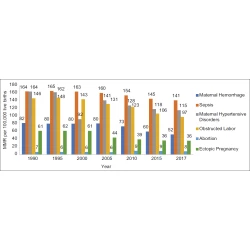
Background: Despite the global progress made in reducing maternal mortality in the past two decades, the health of adolescents and young adult women (10-24 years) has been neglected based on the wrong assumption that they are healthy, especially in a developing country like Nigeria; this is despite the fact that adolescents and young adults (AYA) constitute over 16% of Nigeria’s population. Thus, this study aimed to determine the levels, trends, and causes of maternal mortality among AYA women aged 10-24 years in Nigeria. Methods: This was a cross-sectional study that utilized secondary data sets running from 1990 to 2017 from the Global Burden of Disease Study’s (GBD) online interactive tool downloaded from the Global Health Data Exchange (GHDx) platform. From the database, we extracted the numbers of maternal deaths (10-49 years), adolescent and young adults’ maternal deaths (10-24 years), the proportion of maternal deaths (10-24 years), and both maternal mortality ratio and rate for 15- 49 years old and 10-24 years old in the form of Comma separated values (CSV) and converted into XLS file in Microsoft (MS) Excel format for the analysis. Frequencies, proportions, and charts were generated using MS Excel. Result: A total of 122,107 maternal deaths occurred among adolescents and young adults (AYA), which is 26% of all deaths occurring among 10-49 years old. Year-to-year changes in the absolute numbers of maternal deaths among AYA showed that it ranged from 3,866 (1990) to 4,451 (2017), showing a slight upward increase over the period; however, both AYA maternal mortality ratio and rate show consistent declines over the period. AYA maternal mortality ratio (MMR) for adolescents aged 15-19 years was 17% higher than for young adults aged 20-24 years. Sepsis was the leading cause of adolescent maternal death (MMR of 168), followed by maternal hypertensive disorder, obstructed labor, maternal hemorrhage, ectopic pregnancy, and abortion. A total of 460,155 maternal deaths occurred in women aged 10-49 years during the study period. Maternal deaths in the age group 10-24 years ranged from 3,866 (29.8%) in 1990 to 4,451 (25.1%) in 2017. The maternal mortality ratio in women aged 10-49 years declined by about 30% for the 1990 – 2017 period. Conclusion and Implications for Translation: The study showed that adolescents and young adults are at increased risk of maternal deaths in Nigeria. Therefore, multi-faceted maternal health programs in the country need to target this age group to prevent maternal deaths
Downloads
Similar Articles
- Mariam Amer Al-Tell, Khulud Mansor, Stress Coping Strategies Among Secondary School-Aged Students in Government Schools in Northern West Bank/Palestine , Vol. 3 No. 1 (2019): The International Journal of Translational Medical Research and Public Health (IJTMRPH)
- Romuladus E Azuine, Gopal K Singh, Shanita D Williams, Evangeline T Oparaocha, Shiv C Mathur, Translating Public and Population Health Research into Policy and Actions: The International Journal of Translational Medical Research and Public Health (IJTMRPH) , Vol. 1 No. 1 (2017): The International Journal of Translational Medical Research and Public Health (IJTMRPH)
- Elizabeth Armstrong Mensah, Maria Adjini, Bria Pringle-Weston, Akwasi Akosah, Rachael Addo, Late Dementia Diagnosis Among Elderly Minority Populations in the United States: Causes, Effects, and Addressing Inequities , Vol. 8 No. Continuous (2024): The International Journal of Translational Medical Research and Public Health (IJTMRPH)
- Matiur Rahman, Kaoser Bin Siddique, Mohammad Mahbub Ur Rahim, Cancer Registry in Bangladesh: Challenges and Opportunities , Vol. 8 No. Continuous (2024): The International Journal of Translational Medical Research and Public Health (IJTMRPH)
- Deepa Dongarwar, Ayleen A Hernandez, Laura Miranda, Hamisu M Salihu, Examining Trends in Black-White Disparity in Traumatic Spinal Cord Injuries among Pregnancy-Related Hospitalizations in the United States , Vol. 6 No. 1 (2022): The International Journal of Translational Medical Research and Public Health (IJTMRPH)
- Godefroid M.A Musema, Ali M Mapatano, Desire K Tshala, Patrick K Kayembe, HIV-1-Syphilis Co-infection Associated with High Viral Load in Female Sex Workers in the Democratic Republic of the Congo , Vol. 4 No. 1 (2020): The International Journal of Translational Medical Research and Public Health (IJTMRPH)
- Gopal K. Singh, Hyunjung Lee, Lyoung Hee Kim, Gem P Daus, Promoting Health Literacy as an Important Initiative in Reducing Health Disparities and Advancing Health Equity , Vol. 8 No. Continuous (2024): The International Journal of Translational Medical Research and Public Health (IJTMRPH)
- Elizabeth A Armstrong-Mensah, Transitioning a Public Health Study Abroad Program to Virtual Format During the COVID-19 Pandemic: Implications for Public Health Practice , Vol. 6 No. 1 (2022): The International Journal of Translational Medical Research and Public Health (IJTMRPH)
- Valerie Luzi, The U.S. Opioid Crisis: Decriminalization as a Potential Approach , Vol. 4 No. 1 (2020): The International Journal of Translational Medical Research and Public Health (IJTMRPH)
- Adrian H.P. Palmer, Physiotherapy – An Effective but Underutilized Strategy for Strengthening Public Health , Vol. 9 No. Continuous (2025): The International Journal of Translational Medical Research and Public Health (IJTMRPH)
You may also start an advanced similarity search for this article.
Published
How to Cite
Issue
Section
License
Copyright © 2022 Tukur Dahiru, Awawu G Nmadu, Adegboyega M Oyefabi, Clement Woje, Bilkisu Nwankwo, Zainab K Muhammad-Idris. Published by Global Health and Education Projects, Inc., USA.

This is an open-access article distributed under the terms of the Creative Commons Attribution-NonCommercial-ShareAlike 4.0 International License , which permits others to remix, transform, and build upon the work non-commercially, provided the original author is credited and the new creations are licensed under the same terms.



 .
.

