
Factors Associated with Utilization of Postnatal Care Services in Mali, West Africa Bright Opoku Ahin
DOI:
https://doi.org/10.21106/ijtmrph.318Keywords:
- Women’s health,
- Childbearing women,
- Mali,
- Maternal health,
- Postnatal care services utilization,
- Public health,
- Health insurance,
- Care utilization,
- Physical health,
- Mental health
Abstract
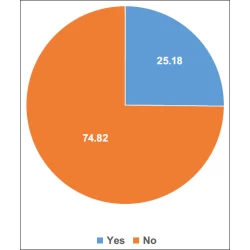
Background and Objective: Postnatal care is recognized as one of the most effective ways of preventing and managing physical and mental disabilities that occur during the postpartum period. Despite the importance of postnatal care, its utilization is low in Mali. The present study investigates factors associated with utilization of postnatal care services in Mali. Methods: A total of 5,778 women who had complete information on all the variables of interest were included in our study. The data were analyzed with Stata version 14.2 by employing a multilevel logistic regression approach. The results were presented using adjusted odds ratios (aOR) at 95% confidence interval (CI). Results: We found that 25.18% of childbearing women in Mali utilized postnatal care. Women with no education (aOR=1.28, 95% CI=1.02-1.62) and those with primary level of education (OR=1.38, 95% CI=1.06- 1.81) had higher odds of postnatal care uptake, compared to those with secondary/higher education. On the contrary, postnatal care service utilization was lower among women who were not covered by health insurance (aOR=0.63, 95% CI=0.46-0.88), those who were not working (aOR=0.82, 95% CI=0.70-0.96), and those who were not exposed to mass media (aOR=0.80, 95% CI=0.70-0.93). Similarly, compared to women in the Mopti region, women in all other regions were less likely to utilize postnatal care services. Postnatal care service utilization was lower among women in communities with low educational level (aOR = 0.42, 95% CI=0.27-0.66) and medium socio-economic status (aOR=0.59, 95% CI=0.36-0.99). Conclusion and Implications for Translation: The study revealed several individual, household and community level factors as predictors of utilization of postnatal care services in Mali. Public health interventions intended to improve postnatal care services uptake in Mali should pay attention to these factors. This will help achieve the Sustainable Development Goal 3.1 which focuses on reducing the global maternal mortality ratio to less than 70 per 100 000 live births by 2030.
Downloads
Most read articles by the same author(s)
- Bright Opoku Ahinkorah, Edward Kwabena Ameyaw, Abdul-Aziz Seidu, Sanni Yaya, Predictors of Female Genital Mutilation or Cutting Among Daughters of Women in Guinea, West Africa , International Journal of Translational Medical Research and Public Health: Vol. 5 No. 1 (2021): The International Journal of Translational Medical Research and Public Health (IJTMRPH)
- Albert Apotele Nyaaba, Edward Kwabena Ameyaw, Matthew Ayamga, Beyond the COVID-19 Vaccine: The “Epidemic” of Violence in Ghana and Strategies to Keep Women and Children Safe from Gender-Based Violence , International Journal of Translational Medical Research and Public Health: Vol. 6 No. 1 (2022): The International Journal of Translational Medical Research and Public Health (IJTMRPH)
- Betregiorgis Zegeye, Nicholas Kofi Adjei, Bright Opoku Ahinkorah, Edward Kwabena Ameyaw, Eugene Budu, Abdul-Aziz Seidu, Dina Idriss-Wheeler, Sanni Yaya, Barriers and Facilitators to Accessing Health Care Services among Married Women in Ethiopia: a Multi-level Analysis of the Ethiopia Demographic and Health Survey , International Journal of Translational Medical Research and Public Health: Vol. 5 No. 2 (2021): The International Journal of Translational Medical Research and Public Health (IJTMRPH)
Similar Articles
- semvua kilonzo, Hyasinta Jaka, Sylvanus Mapunda, Knowledge and Risk Assessment of Hepatitis B Infection among Barbers and Beauty Salon Workers in Mwanza, Tanzania , Vol. 8 No. Continuous (2024): The International Journal of Translational Medical Research and Public Health (IJTMRPH)
- Michael Quinn Patton, Laura Elisabeth Gressler, Sustainable, Cooperative, Inclusive, Organized Networks, and Translational Health: A Book Review of Saving Societies from Within: Innovation and Equity through Inter-Organizational Networks , Vol. 9 No. Special Collection (2025): The International Journal of Translational Medical Research and Public Health (IJTMRPH)
- Lind Grant-Oyeye, Full Range Leadership Approach: An Actionable Framework for Developing Resilient Public Health Leaders , Vol. 8 No. Continuous (2024): The International Journal of Translational Medical Research and Public Health (IJTMRPH)
- Ahmed A Bulama, Jane Goodman-Brown, Polio Eradication in Nigeria and India: A Systematic Review of Challenges and Successes , Vol. 3 No. 2 (2019): The International Journal of Translational Medical Research and Public Health (IJTMRPH)
- George Ikpe, Juliet Enukeme, Chukwuemeka Amuta, Ikenna Nwakanma, Orieji Agomoh, Okwudili Chukwudinma, Chioma Ukanwa, Peter Nwaokenneya, Advanced HIV Disease among Persons Newly Diagnosed with HIV: A Hospital-Based Study in Abia State, Nigeria , Vol. 9 No. Continuous (2025): The International Journal of Translational Medical Research and Public Health (IJTMRPH)
- Deepa Dongarwar, Ayleen A Hernandez, Laura Miranda, Hamisu M Salihu, Examining Trends in Black-White Disparity in Traumatic Spinal Cord Injuries among Pregnancy-Related Hospitalizations in the United States , Vol. 6 No. 1 (2022): The International Journal of Translational Medical Research and Public Health (IJTMRPH)
- Uksim Qadri, Bashir Ahmad Fomda, Saleem Javaid Wani, Shugufta Roohi, Sanam Rasool Wani, Hepatitis A and E: Prevalence, Epidemiology and Co-infection among Patients with Acute Viral Hepatitis , Vol. 9 No. Continuous (2025): The International Journal of Translational Medical Research and Public Health (IJTMRPH)
- Musa M Dogara, Saadatu Ahmad, Babalola J Balogun, Salwa S Dawaki, Muzammil B Mustapha, Aminu U Abdurrahman, Lawal Bala, Abubakar Zakari, David U Livingstone, Schistosomiasis and Associated Risk Factors Among School-Aged Children in Northern Nigeria , Vol. 4 No. 2 (2020): The International Journal of Translational Medical Research and Public Health (IJTMRPH)
- Selina Khatun, Rafiqul Islam, Nazrul Islam Mondal, Nazrul Hoque, Clyde McNeil, Fatema Siddiqua, Sociodemographic Determinants of Early, Normal, and Delayed Menarche among Female College-Aged Students in Bangladesh , Vol. 1 No. 1 (2017): The International Journal of Translational Medical Research and Public Health (IJTMRPH)
- Elisa J. Gordon, Zubairu Iliyasu, Elizabeth S. Rose, Fatimah I. Tsiga-Ahmed, Usman J. Wudil, Aishatu L. Adamu, C. William Wester, Muktar H. Aliyu, Building Capacity for the Ethical Conduct of Genetic and Genomic Research in Nigeria: The Vanderbilt-Nigeria Research Ethics Training Program , Vol. 9 No. Continuous (2025): The International Journal of Translational Medical Research and Public Health (IJTMRPH)
<< < 5 6 7 8 9 10 11 12 13 14 > >>
You may also start an advanced similarity search for this article.
Published
How to Cite
Issue
Section
License
Copyright © 2021 Bright Opoku Ahinkorah, Abdul-Aziz Seidu, Eugene Budu, Ebenezer Kwesi Armah-Ansah, Ebenezer Agbaglo, Collins Adu, Edward Kwabena Ameyaw, Sanni Yaya. Published by Global Health and Education Projects, Inc., USA.

This is an open-access article distributed under the terms of the Creative Commons Attribution-NonCommercial-ShareAlike 4.0 International License , which permits others to remix, transform, and build upon the work non-commercially, provided the original author is credited and the new creations are licensed under the same terms.



 .
.

