
Prevalence and Associated Risk Factors of Postpartum Depression among Mothers in Pennsylvania, United States: An Analysis of the Pregnancy Risk Assessment Monitoring System (PRAMS) Data, 2012-2015
DOI:
https://doi.org/10.21106/ijtmrph.386Keywords:
- Depression,
- Postpartum Depression,
- Prevalence,
- Risk Factors,
- Surveillance,
- Pregnancy,
- Maternal Health,
- PRAMS
Abstract
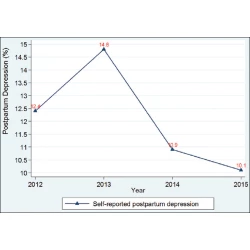
Background: Postpartum depression (PPD) is the most common morbidity among new mothers. With an estimated 140,000 resident births annually in the state of Pennsylvania, United States, no publication is available about the prevalence and risk factors associated with PPD specifically for Pennsylvania. This study aims to estimate the self-reported prevalence and risk factors associated with PPD. Methods: Weighted Pregnancy Risk Assessment Monitoring System (PRAMS) surveillance data of 4,022 Pennsylvania mothers with live birth(s) during 2012-2015 were analyzed. Descriptive statistics were used for mothers’ characteristics. Between-group differences were evaluated using the Chi-square test. Risk factors associated with PPD were analyzed by logistic regression models. All analyses were performed using Stata version 13 (STATA Corp., College Station, TX), taking into account the complex survey design, and P-values <0.05 (2-tailed) were considered statistically significant. Results: Of the 4,022 mothers, the overall prevalence of PPD was 12.1% (515 mothers); the prevalence was 12.4% (108) in 2012, spiked to 14.8% (156) in 2013, then significantly declined to 10.9% (127) in 2014 and 10.1% (124) in 2015 (p=0.03). In a multivariable logistic model, significant risk factors included depression before pregnancy (adjusted odds ratio [aOR]: 3.7, 95% CI: 2.3-6.0), abuse before or during pregnancy (aOR: 3.5, 95% CI: 1.6-7.3), the mother’s job loss (aOR: 2.1, 95% CI: 1.3-3.4), extended time away from husband/partner due to military deployment or work-related travel (aOR: 2.3, 95% CI: 1.1-4.5), a husband/partner not wanting the pregnancy (aOR: 1.7, 95% CI: 1.1-2.9), and arguing more than usual with a husband/partner (aOR: 1.6, 95% CI: 1.4-2.4). Conclusion and Implication for Translation: PPD is relatively common in Pennsylvania; however, the prevalence declined significantly during the study period. Depression before pregnancy, abuse before or during pregnancy, job loss, extended time away from husband/partner due to military deployment or workrelated travel, husband/partner not wanting the pregnancy, or arguing more than usual with a husband/ partner increased the odds of experiencing PPD. Further studies should be conducted on approaches to prevent PPD among new mothers.
Downloads
Similar Articles
- Anna Kallasidou, Konstantinos Giannakou, Costas A. Christophi, Maria Kyprianidou, Association between Components of Metabolic Syndrome and Rheumatic, Cardiovascular, Gastrointestinal, and Chronic Kidney Disease: A Cross-Sectional Study of Adults in Cyprus , Vol. 9 No. Continuous (2025): The International Journal of Translational Medical Research and Public Health (IJTMRPH)
- Elizabeth Armstrong Mensah, Maria Adjini, Bria Pringle-Weston, Akwasi Akosah, Rachael Addo, Late Dementia Diagnosis Among Elderly Minority Populations in the United States: Causes, Effects, and Addressing Inequities , Vol. 8 No. Continuous (2024): The International Journal of Translational Medical Research and Public Health (IJTMRPH)
- Bashir Faiza, Hassan Mehmood, Sumera Naz, Saima Naz, Prevalence and Determinants of Substance Abuse Among Slum Dwellers in Islamabad- Pakistan , Vol. 3 No. 2 (2019): The International Journal of Translational Medical Research and Public Health (IJTMRPH)
- Mehrete Girmay, Gopal K Singh, Social Isolation, Loneliness, and Mental and Emotional Well-being among International Students in the United States , Vol. 3 No. 2 (2019): The International Journal of Translational Medical Research and Public Health (IJTMRPH)
- Hyunjung Lee, Gopal K Singh, Marked Disparities in Cardiovascular Disease Mortality by Levels of Happiness and Life Satisfaction in the United States , Vol. 4 No. 2 (2020): The International Journal of Translational Medical Research and Public Health (IJTMRPH)
- Chongo Clays Siwale, Seter Siziya, Factors Associated with Alcohol Consumption Among Students in High-Cost Schools in Lusaka, Zambia , Vol. 3 No. 1 (2019): The International Journal of Translational Medical Research and Public Health (IJTMRPH)
- Caroline Okeke, Evangeline T Oparaocha, Book of Abstracts: 3rd International Congress on Health Sciences and Technology, School of Health Technology, Federal University of Technology Owerri, Nigeria, 8-11 August, 2018 , Vol. 2 No. S1 (2018): The International Journal of Translational Medical Research and Public Health (IJTMRPH)
- Anagha Lokhande, Improving Reproductive and Maternal Healthcare Uptake in India: An Evaluation of Project Ujjwal Public-Private Partnership Program , Vol. 7 No. 2 (2023): The International Journal of Translational Medical Research and Public Health (IJTMRPH)
- Sorochi Iloanusi, Osaro Mgbere, Nchebe-Jah R Iloanusi, Ismaeel Yunusa, Ekere J Essien, COVID-19 Related Misconceptions and Prevention Practices Among Residents of a Populous Commercial City in Nigeria , Vol. 5 No. 2 (2021): The International Journal of Translational Medical Research and Public Health (IJTMRPH)
- Maureen Atieno Adoyo, Yeri M Kombe, Gestational Diabetes Mellitus and Associated Health Risk Outcomes in Mothers and Neonates , Vol. 4 No. 1 (2020): The International Journal of Translational Medical Research and Public Health (IJTMRPH)
<< < 3 4 5 6 7 8 9 10 11 12 > >>
You may also start an advanced similarity search for this article.
Published
How to Cite
Issue
Section
License
Copyright © 2021 Nhiem Luong, Sara E Thuma, Angelo Santore, Zhen-qiang Ma, Sharon M Watkins, Erin McCarty. Published by Global Health and Education Projects, Inc., USA.

This is an open-access article distributed under the terms of the Creative Commons Attribution-NonCommercial-ShareAlike 4.0 International License , which permits others to remix, transform, and build upon the work non-commercially, provided the original author is credited and the new creations are licensed under the same terms.



 .
.

