
Digital Divide: Marked Disparities in Computer and Broadband Internet Use and Associated Health Inequalities in the United States
DOI:
https://doi.org/10.21106/ijtmrph.148Keywords:
- Digital Divide,
- Broadband Internet,
- Computer Use,
- Disability,
- Health Insurance,
- CauseSpecific Mortality,
- Morbidity,
- Health Behaviors
Abstract
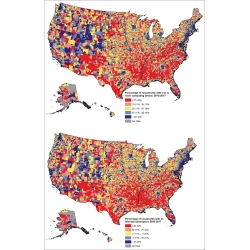
Background: Despite the considerable increase in computer and internet use over the past two decades, few studies have examined socioeconomic, demographic, and health characteristics associated with computer and internet use in the United States. Community-level differences in computer and internet use and associated disparities in health and mortality indicators have not been analyzed. This study examines these associations at the individual and community level using national census, health, and mortality data. Methods: We analyzed data from the 2017 American Community Survey (ACS) Micro-data Sample, the 2013-2017 ACS Summary File, National Vital Statistics System, and 2019 County Health Rankings and Roadmaps. Health and socioeconomic characteristics associated with broadband internet and computer use among adults aged ≥18 were modeled by logistic regression (N=2,385,595). Results: In 2017, 89.7% of Asian/Pacific Islanders (APIs) had broadband internet service, compared with 66.0% of American Indians/Alaska Natives (AIANs), 77.2% of Blacks/African-Americans, 78.8% of Hispanics, and 83.5% of non-Hispanic Whites. APIs (97.4%) were more likely than other racial/ethnic groups to own or use a computer (including smartphones), while AIANs (80.3%) were less likely. Socioeconomic gradients in internet and computer use were marked. Those below the poverty level and with less than a high school education reported 18 and 15 percentage points lower rates of internet and computer use respectively. Compared to metropolitan areas, nonmetropolitan areas had lower internet access (80.3% vs. 69.7%) and computer use (88.4% vs. 80.5%). Rural areas and small urban towns had the lowest level of internet and computer use. Risks of disabilities and lack of health insurance were greater among persons with lower broadband internet and computer access. Communities with low internet and computer use had seven years shorter life expectancy than communities with high use and were at increased risks of mortality from various chronic conditions, poor health, mental distress, hospitalization, smoking, obesity, and physical inactivity. Conclusions and Implications for Translation: Significant socioeconomic and racial/ethnic disparities in internet and computer use and associated health inequalities exist in the US. Closing the social divide in internet and computer use can positively impact individual empowerment, educational attainment, economic growth, community development, access to health care and health-related information, and health promotions efforts.
Downloads
Most read articles by the same author(s)
- Mehrete Girmay, Gopal K Singh, Social Isolation, Loneliness, and Mental and Emotional Well-being among International Students in the United States , International Journal of Translational Medical Research and Public Health: Vol. 3 No. 2 (2019): The International Journal of Translational Medical Research and Public Health (IJTMRPH)
- Hyunjung Lee, Gopal K Singh, Racial and Ethnic Disparities in the Mental Health Impact of the COVID-19 Pandemic in the United States: Analysis of 3 Million Americans from the National Health Interview Survey and Household Pulse Survey , International Journal of Translational Medical Research and Public Health: Vol. 6 No. 2 (2022): The International Journal of Translational Medical Research and Public Health (IJTMRPH)
- Gopal K Singh, Shanita D Williams, Hyunjung Lee, Elijah K Martin, Michelle Allender, Christine T Ramey, Trends in Physical and Mental Health, Mortality, Life Expectancy, and Social Inequalities Among American Indians and Alaska Natives, 1990-2019 , International Journal of Translational Medical Research and Public Health: Vol. 5 No. 2 (2021): The International Journal of Translational Medical Research and Public Health (IJTMRPH)
- Romuladus E Azuine, Gopal K Singh, Shanita D Williams, Evangeline T Oparaocha, Shiv C Mathur, Translating Public and Population Health Research into Policy and Actions: The International Journal of Translational Medical Research and Public Health (IJTMRPH) , International Journal of Translational Medical Research and Public Health: Vol. 1 No. 1 (2017): The International Journal of Translational Medical Research and Public Health (IJTMRPH)
- Gopal K Singh, Hyunjung Lee, Romuladus E Azuine, Food Insecurity among Lesbian, Gay, Bisexual, and Transgender Adults During the COVID-19 Pandemic in the United States, July-October 2021 , International Journal of Translational Medical Research and Public Health: Vol. 6 No. 1 (2022): The International Journal of Translational Medical Research and Public Health (IJTMRPH)
- Hyunjung Lee, Gopal K Singh, Marked Disparities in Cardiovascular Disease Mortality by Levels of Happiness and Life Satisfaction in the United States , International Journal of Translational Medical Research and Public Health: Vol. 4 No. 2 (2020): The International Journal of Translational Medical Research and Public Health (IJTMRPH)
- Gopal K Singh, Hyunjung Lee, Romuladus E Azuine, Growing Job-Related Income Losses, Increasing Social Inequalities, and Physical and Mental Health Impact During the COVID-19 Pandemic, United States, April – December 2020 , International Journal of Translational Medical Research and Public Health: Vol. 5 No. 2 (2021): The International Journal of Translational Medical Research and Public Health (IJTMRPH)
- Gopal K Singh, Hyunjung Lee, Gem P Daus, Prevalence and Sociodemographic and Behavioral Correlates of Psychological Distress among Lesbian, Gay, and Bisexual Adults in the United States, 2013-2018 , International Journal of Translational Medical Research and Public Health: Vol. 6 No. 1 (2022): The International Journal of Translational Medical Research and Public Health (IJTMRPH)
- Elijah K Martin, Lea Jacobson, Gopal K Singh, Payam Sheikhatari, Mehrete Girmay, Smoking-Free Policies and Smoking Behaviors among Historically Black Colleges and Universities Students in the United States , International Journal of Translational Medical Research and Public Health: Vol. 4 No. 2 (2020): The International Journal of Translational Medical Research and Public Health (IJTMRPH)
- Hyunjung Lee, Gopal K Singh, Association of Happiness and Life Satisfaction with Cancer Mortality in the United States: A Longitudinal Analysis , International Journal of Translational Medical Research and Public Health: Vol. 4 No. 2 (2020): The International Journal of Translational Medical Research and Public Health (IJTMRPH)
Similar Articles
- Gopal K Singh, Shanita D Williams, Hyunjung Lee, Elijah K Martin, Michelle Allender, Christine T Ramey, Trends in Physical and Mental Health, Mortality, Life Expectancy, and Social Inequalities Among American Indians and Alaska Natives, 1990-2019 , Vol. 5 No. 2 (2021): The International Journal of Translational Medical Research and Public Health (IJTMRPH)
- Osman Nuri Yogurtcu, Laura E Gressler, Jens Eldrup-Jorgensen, Kashif Haqqi, Colin Shepard, Orestis A Panagiotou, Santiago J Molina, Philip P Goodney, Ali B Abbasi, Brian S Anderson, Wilbur C Hadden, James E Tcheng, Julia Skapik, Gregory Pappas, Building Real-World Evidence Infrastructure to Improve Health and Healthcare in the United States: Part III— Questions for Translational Science and Action Theory , Vol. 9 No. Special Collection (2025): The International Journal of Translational Medical Research and Public Health (IJTMRPH)
- Gopal K. Singh, Hyunjung Lee, Lyoung Hee Kim, Gem P Daus, Promoting Health Literacy as an Important Initiative in Reducing Health Disparities and Advancing Health Equity , Vol. 8 No. Continuous (2024): The International Journal of Translational Medical Research and Public Health (IJTMRPH)
- Japhet Adeniran Olugbogi, Saheed Akinmayowa Lawal, Oluwaseyi Senapon Babatunde, Evaluation of Access, Satisfaction and Perceived Quality of a Free Community Medical Outreach in Badagry, Lagos, Southwest Nigeria , Vol. 10 (2026): The International Journal of Translational Medical Research and Public Health (IJTMRPH)
- Hyunjung Lee, Gopal K Singh, Estimating Contributions of Social and Behavioral Factors to Cardiovascular Disease, Cancer, COPD, and Unintentional-Injury Mortality Disparities by Psychological Distress in the United States: A Blinder-Oaxaca Decomposition Analysis of the 1997-2014 NHIS , Vol. 5 No. 2 (2021): The International Journal of Translational Medical Research and Public Health (IJTMRPH)
- Osman Nuri Yogurtcu, Laura E. Gressler, Jens Eldrup-Jorgensen, Kashif Haqqi, Colin Shepard, Orestis A. Panagiotou, Santiago J. Molina, Philip P. Goodney, Ali B. Abbasi, Brian S. Anderson, Wilbur C. Hadden, James E. Tcheng, Julia Skapik, Gregory Pappas, Building Real-World Evidence Infrastructure to Improve Health and Healthcare in the United States: Part I—Coordinated Registry Networks and Systemic Coordinated Inter-Organizational Networks , Vol. 9 No. Special Collection (2025): The International Journal of Translational Medical Research and Public Health (IJTMRPH)
- Osman Nuri Yogurtcu, Laura E. Gressler, Jens Eldrup-Jorgensen, Kashif Haqqi, Colin Shepard, Orestis A. Panagiotou, Santiago J. Molina, Philip P. Goodney, Ali B. Abbasi, Brian S. Anderson, Wilbur C. Hadden, James E. Tcheng, Julia Skapik, Gregory Pappas, Building Real-World Evidence Infrastructure to Improve Health and Healthcare in the United States: Part II—How Coordinated Registry Networks Operate Like Systemic Coordinated Inter-Organizational Networks , Vol. 9 No. Special Collection (2025): The International Journal of Translational Medical Research and Public Health (IJTMRPH)
- Gopal K. Singh, Lyoung Hee Kim, Hyunjung Lee, Romuladus E Azuine, Disparities in Prevalence of COVID-19, Long COVID, Disease Severity, and Mental Health Outcomes among US Adults by Industrial Sector of Employment, September-November 2022 , Vol. 7 No. 2 (2023): The International Journal of Translational Medical Research and Public Health (IJTMRPH)
- Oluwatosin Olateju, Ilona Argirion, Melanie Bolden, Stephanie Klapper, Jonas Nguh, Chidubem Egboluche, Addressing Health Disparities in Maryland Communities: Insights from a Public Health State Affiliate and Strategic Advocacy Recommendations , Vol. 9 No. Continuous (2025): The International Journal of Translational Medical Research and Public Health (IJTMRPH)
- Gopal K. Singh, Hyunjung Lee, Lyoung Hee Kim, Romuladus E Azuine, State and Metropolitan Area Disparities in Long COVID-19 and Related Symptoms among US Adults, June-October 2022 , Vol. 7 No. 2 (2023): The International Journal of Translational Medical Research and Public Health (IJTMRPH)
You may also start an advanced similarity search for this article.
Published
How to Cite
Issue
Section
License
Copyright © 2020 Gopal K Singh, Mehrete Girmay, Michelle Allender, Christine T Ramey. Published by Global Health and Education Projects, Inc., USA.

This is an open-access article distributed under the terms of the Creative Commons Attribution-NonCommercial-ShareAlike 4.0 International License , which permits others to remix, transform, and build upon the work non-commercially, provided the original author is credited and the new creations are licensed under the same terms.



 .
.

