
Polio Eradication in Nigeria and India: A Systematic Review of Challenges and Successes
DOI:
https://doi.org/10.21106/ijtmrph.92Keywords:
- Polio,
- Immunization,
- Nigeria,
- India,
- Pakistan,
- Eradication,
- Systematic Review
Abstract
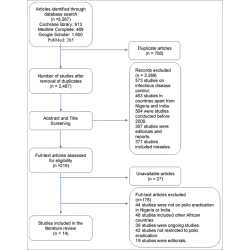
Background: The global eradication of polio is considered an emergency and an unaccomplished task until completely eliminated. Vaccinating children against the polio virus confers immunity on them and breaks the transmission of the polio virus. Afghanistan, Nigeria and Pakistan remain the only three countries in the world that have not eliminated polio. The aims of this paper were to: (1) to identify the factors that impact the failure to eliminate polio from Nigeria and (2) determine the factors that led to the successful elimination of polio from India. Methods: A systematic literature review was carried out to meet the above research objectives. Four electronic databases were searched (Cochrane Library, Medline, PubMed and Google Scholar) and articles that fulfilled the inclusion and exclusion criteria were selected and critically appraised. Results: In all, 98 articles were retrieved. After selection based on our selection criteria, fourteen studies were identified and included in the study. These were 5 systematic reviews: 3 cross-sectional studies, 3 mixed methods studies, 2 case-control studies and one quantitative (survey) study. In all, seven themes were identified from the review of the articles. Four themes were identified from the factors associated with the failure to eliminate polio from Nigeria: (1) Failure of the oral polio vaccine (OPV); (2) Institutional and geographical failures in vaccine programs; (3) Program and campaign management limitations; and (4) Vaccine refusal. Similarly, three themes were identified from the factors that contributed to the elimination of polio from India: (1) Replacement of the trivalent OPV with the monovalent and bivalent OPVs; (2) Implementation of intensive social mobilization strategies; and (3) Effective program micro planning and campaign management. Conclusion and Implications for Translation: Based on the findings from the literature review, we highlight areas where Nigeria can learn from India in its quest to eliminate polio. These factors can form the basis for future theoretical and policy reforms in the fight against polio not only in Nigeria but in countries where it remains endemic. Further research should compare the success of polio eradication in other countries.
Downloads
Similar Articles
- Ogechukwu B Aribodor, Chinyelu A Ekwunife, Olufemi S Sam-Wobo, Dennis N Aribodor, Risk Factors and Socio-demographic Determinants of Intestinal Helminthiasis among Children in Schools that Implemented the Homegrown School Feeding Program in Ekwulobia, Anambra State, Southeast Nigeria , Vol. 2 No. 1 (2018): The International Journal of Translational Medical Research and Public Health (IJTMRPH)
- Sorochi Iloanusi, Osaro Mgbere, Nchebe-Jah R Iloanusi, Ismaeel Yunusa, Ekere J Essien, COVID-19 Related Misconceptions and Prevention Practices Among Residents of a Populous Commercial City in Nigeria , Vol. 5 No. 2 (2021): The International Journal of Translational Medical Research and Public Health (IJTMRPH)
- Mayowa Jeremiah Adeniyi, Ayoola Awosika, Samuel Agaba Ameh, John Obogwu, Samuel Ijoganu, Phoebe Nwamaka Kanikwu, Impact of Short-Term Hot Water Hand Immersion on Physiological Responses to Different Orthostatic Durations , Vol. 10 (2026): The International Journal of Translational Medical Research and Public Health (IJTMRPH)
- Musa Baba Maiyaki, Garba Dahiru, Amina Abdullahi, Tijjani Hussaini, Sabitu Shuaibu, Mohammed Auwal Ibrahim, Auwal Adamu, Nura Mohammed, Mahmoud Habib Maje, Hamisu M Salihu, Profiles and Characteristics of Patients with Mild to Moderate COVID -19 Disease Phenotypes in a Teaching Hospital in Kano, Northern Nigeria , Vol. 6 No. 1 (2022): The International Journal of Translational Medical Research and Public Health (IJTMRPH)
- Comfort Z Olorunsaiye, Hannah M Degge, Jiana Saigh, Association Between Source of Treatment and Quality of Childhood Diarrhea Management Among Under-Five Children in Nigeria , Vol. 5 No. 2 (2021): The International Journal of Translational Medical Research and Public Health (IJTMRPH)
- Bashir Faiza, Hassan Mehmood, Sumera Naz, Saima Naz, Prevalence and Determinants of Substance Abuse Among Slum Dwellers in Islamabad- Pakistan , Vol. 3 No. 2 (2019): The International Journal of Translational Medical Research and Public Health (IJTMRPH)
- Tukur Dahiru, Awawu G Nmadu, Adegboyega M Oyefabi, Clement Woje, Bilkisu Nwankwo, Zainab K Muhammad-Idris, Levels, Trends, and Causes of Adolescent and Young Adult Maternal Mortality in Nigeria During 1990–2017: Analysis of the 2017 Global Burden of Disease Study Database , Vol. 6 No. 2 (2022): The International Journal of Translational Medical Research and Public Health (IJTMRPH)
- Muktar H Aliyu, Mahmoud U Sani, Donna J Ingles, Fatima I. T siga-Ahmed, Baba M Musa, M. Shannon Byers, Deepa Dongarwar, Hamisu M Salihu, C. William Wester, Building Physician-Scientist Skills in R Programming: A Short Workshop Report , Vol. 6 No. 1 (2022): The International Journal of Translational Medical Research and Public Health (IJTMRPH)
- Shivam Singh, Ashok Sharma, Richa Tripathi, Vitthal Govindappa Huddar, Subhash Gupta, Network Pharmacology and Preliminary in Vitro Evaluation of Piper longum (Indian Long Pepper) in Breast Cancer , Vol. 10 (2026): The International Journal of Translational Medical Research and Public Health (IJTMRPH)
- Akinwale Johnson Ogundipe, Barry Okoro, Charles Igbokwe, Kyriakos Kouveliotis, Eseoghene Fredrick Arigbe, David Akpan, Jimin Sontyo, Elijah Idoko, Care Plan as an Effective Service Tool to Improving Well-being of Vulnerable Households: A Case Study of Lagos and Calabar, Nigeria , Vol. 10 (2026): The International Journal of Translational Medical Research and Public Health (IJTMRPH)
<< < 1 2 3 4 5 6 7 8 9 10 > >>
You may also start an advanced similarity search for this article.
Published
How to Cite
Issue
Section
License
Copyright © 2019 Ahmed A Bulama, Jane Goodman-Brown. Published by Global Health and Education Projects, Inc., USA.

This is an open-access article distributed under the terms of the Creative Commons Attribution-NonCommercial-ShareAlike 4.0 International License , which permits others to remix, transform, and build upon the work non-commercially, provided the original author is credited and the new creations are licensed under the same terms.



 .
.

