
Building Real-World Evidence Infrastructure to Improve Health and Healthcare in the United States: Part III— Questions for Translational Science and Action Theory
DOI:
https://doi.org/10.25259/IJTMRPH_76_2024Keywords:
- Evidence-Based Medicine,
- Learning Health System,
- Public Health,
- Registries
Abstract
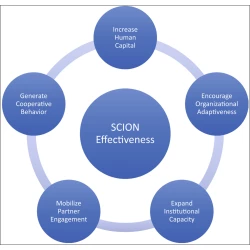
Background and Objective: Previous work in this series has introduced real-world evidence (RWE), coordinated registry networks (CRNs), and systemic, coordinated, inter-organizational networks (SCIONs) theory. The application of SCIONs theory to CRNs illuminates how their structure and function foster trust and cooperation in a network of organizations to successfully address complex problems in healthcare. This third part in the series asks questions about how SCIONs theory can benefit CRNs and how the experience of CRNs can further develop the SCIONs theory. Methods: This manuscript analyzes reciprocal relationships related to SCIONs theory and CRN practice, examining how each can be used to benefit the other. While SCIONs theory has not yet formally been used to direct the development of a CRN, future application is proposed. Conversely, we explored how the practical experiences of CRNs can inform and refine our understanding of SCIONs, including identifying areas for theoretical development and through an exploration of the current limitations of CRNs. Results: The SCIONs theory may usefully direct CRN development in key leadership areas, including increasing human capital, encouraging organizational adaptiveness, expanding institutional capacity, mobilizing political engagement, and generating cooperative behavior. CRNs, guided by SCIONs theory, can offer a pathway towards a more efficient, equitable, and learning-oriented healthcare system. A comprehensive approach proposed for CRNs may facilitate the expansion of the evaluation component in SCIONs theory. Conclusion and Implications for Translation: CRN program managers should prioritize strategic approaches that foster human capital, organizational adaptability, and institutional capacity. Government agencies may consider investments in CRN as a way to build RWE infrastructure that improves quality and efficiency of healthcare broadly. Public discourse may benefit from a clearer understanding of the role of cooperation in society to address issues that government and markets are not well suited to address. The literature on SCIONs can support the non-profit literature in the way the business literature supports the for-profit sector.
Downloads
Most read articles by the same author(s)
- Osman Nuri Yogurtcu, Laura E. Gressler, Jens Eldrup-Jorgensen, Kashif Haqqi, Colin Shepard, Orestis A. Panagiotou, Santiago J. Molina, Philip P. Goodney, Ali B. Abbasi, Brian S. Anderson, Wilbur C. Hadden, James E. Tcheng, Julia Skapik, Gregory Pappas, Building Real-World Evidence Infrastructure to Improve Health and Healthcare in the United States: Part I—Coordinated Registry Networks and Systemic Coordinated Inter-Organizational Networks , International Journal of Translational Medical Research and Public Health: Vol. 9 No. Special Collection (2025): The International Journal of Translational Medical Research and Public Health (IJTMRPH)
- Osman Nuri Yogurtcu, Laura E. Gressler, Jens Eldrup-Jorgensen, Kashif Haqqi, Colin Shepard, Orestis A. Panagiotou, Santiago J. Molina, Philip P. Goodney, Ali B. Abbasi, Brian S. Anderson, Wilbur C. Hadden, James E. Tcheng, Julia Skapik, Gregory Pappas, Building Real-World Evidence Infrastructure to Improve Health and Healthcare in the United States: Part II—How Coordinated Registry Networks Operate Like Systemic Coordinated Inter-Organizational Networks , International Journal of Translational Medical Research and Public Health: Vol. 9 No. Special Collection (2025): The International Journal of Translational Medical Research and Public Health (IJTMRPH)
- Gregory Pappas, Introduction to Special Collection: Building the Real-World Evidence Infrastructure to Accelerate Innovation and Improve Outcomes in Healthcare , International Journal of Translational Medical Research and Public Health: Vol. 9 No. Special Collection (2025): The International Journal of Translational Medical Research and Public Health (IJTMRPH)
Similar Articles
- Judith Eberhardt, Jonathan Ling, A Qualitative Exploration of Perceptions of the COVID-19 Vaccine in the United Kingdom During the Later Stages of the Vaccine Rollout , Vol. 6 No. 1 (2022): The International Journal of Translational Medical Research and Public Health (IJTMRPH)
- Angelique B Willis, Mildred Addo, Lauren E Yoder, Cassandra K Johnson, Sydney L Resler, Leticia J Young, Elizabeth Armstrong-Mensah, Individual and Community Level Factors Related to Sanitation, Water Quality, Treatment and Management in Rural Communities in Accra, Ghana: A Field Study Report , Vol. 6 No. 1 (2022): The International Journal of Translational Medical Research and Public Health (IJTMRPH)
- Deepa Dongarwar, Ayleen A Hernandez, Laura Miranda, Hamisu M Salihu, Examining Trends in Black-White Disparity in Traumatic Spinal Cord Injuries among Pregnancy-Related Hospitalizations in the United States , Vol. 6 No. 1 (2022): The International Journal of Translational Medical Research and Public Health (IJTMRPH)
- Ariel Braverman, Integrating Human Factors in the Healthcare System: Embracing Aviation Methodologies and Artificial Intelligence (AI) to Enhance Provider Performance and Patient Safety , Vol. 8 No. Continuous (2024): The International Journal of Translational Medical Research and Public Health (IJTMRPH)
- Selina Khatun, Rafiqul Islam, Nazrul Islam Mondal, Nazrul Hoque, Clyde McNeil, Fatema Siddiqua, Sociodemographic Determinants of Early, Normal, and Delayed Menarche among Female College-Aged Students in Bangladesh , Vol. 1 No. 1 (2017): The International Journal of Translational Medical Research and Public Health (IJTMRPH)
- Deepa Dongarwar, Brisa Y Garcia, Sitratullah O Maiyegun, Korede K Yusuf, Hamisu M Salihu, COVID-19 Early Vaccination Rates and Gross Domestic Product Per Capita , Vol. 5 No. 1 (2021): The International Journal of Translational Medical Research and Public Health (IJTMRPH)
- Vinod K Ramani, Radheshyam Naik, A Narrative Review of the Pathophysiology of Mucormycosis Infection Among COVID-19 Patients in India: Epidemiology and Clinical Implications , Vol. 6 No. 1 (2022): The International Journal of Translational Medical Research and Public Health (IJTMRPH)
- Deepa Dongarwar, Hamisu M Salihu, COVID-19 Vaccination Rates by Global Universal Health Care Coverage Status , Vol. 5 No. 1 (2021): The International Journal of Translational Medical Research and Public Health (IJTMRPH)
- Cameran M Mosley, Emmanuel Ofori, Caylin E Andrews, Elizabeth Armstrong-Mensah, Individual and Community Level Factors Related to HIV Diagnosis, Treatment, and Stigma in Kumasi, Ghana: A Field Report , Vol. 6 No. 1 (2022): The International Journal of Translational Medical Research and Public Health (IJTMRPH)
- Anayra Túa-López, Fabián Román, The Neuroscience of Social Exclusion: Developmental and Public Health Implications Across the Life-Course , Vol. 9 No. Continuous (2025): The International Journal of Translational Medical Research and Public Health (IJTMRPH)
<< < 7 8 9 10 11 12 13 14 15 > >>
You may also start an advanced similarity search for this article.
Published
How to Cite
Issue
Section
License
Copyright © 2025 Osman Nuri Yogurtcu, Laura E Gressler, Jens Eldrup-Jorgensen, Kashif Haqqi, Colin Shepard, Orestis A Panagiotou, Santiago J Molina, Philip P Goodney, Ali B Abbasi, Brian S Anderson, Wilbur C Hadden, James E Tcheng, Julia Skapik, Gregory Pappas. Published by Global Health and Education Projects, Inc., USA.

This is an open-access article distributed under the terms of the Creative Commons Attribution-NonCommercial-ShareAlike 4.0 International License , which permits others to remix, transform, and build upon the work non-commercially, provided the original author is credited and the new creations are licensed under the same terms.



 .
.

