
Network Pharmacology and Preliminary in Vitro Evaluation of Piper longum (Indian Long Pepper) in Breast Cancer
DOI:
https://doi.org/10.21106/IJTMRPH_266_2026Keywords:
- Breast Cancer,
- Piper Longum,
- Network Pharmacology,
- Molecular Docking,
- Cell Proliferation
Abstract
Background and Objectives: Piper longum (Indian Long Pepper) contains phytochemicals reported to have anticancer activity, but their targets and effects in breast-cancer models remain uncertain. This exploratory study combined network pharmacology, analysis of public breast cancer data, molecular docking, MCF-7 viability, DNA cell cycle, and apoptosis assays.
Methods: Nineteen compounds from P. longum fruit were identified using the literature and phytochemical databases. Target prediction tools and cancer gene databases were used to identify interactions with breast cancer genes. Protein–protein interaction, gene ontology, and pathway analyses highlighted key targets. Molecular docking was used to evaluate binding affinities, and in vitro assays assessed cytotoxicity in MCF-7 breast cancer cells.
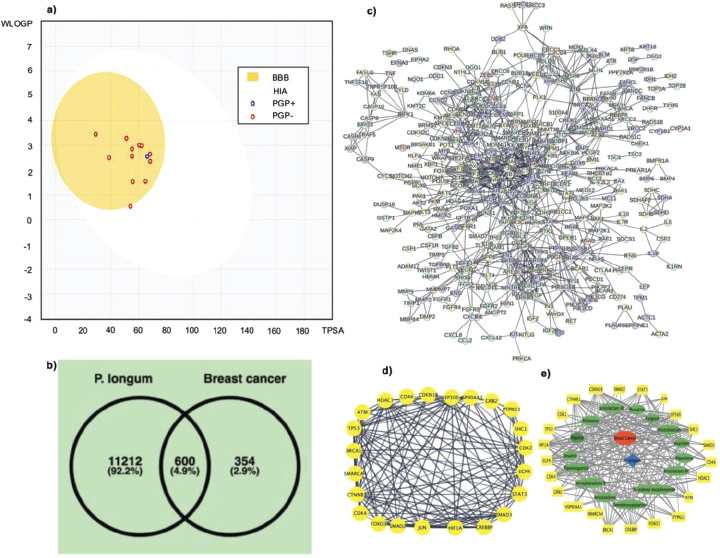
Results: This study revealed 600 common gene targets between P. longum compounds and breast cancer. Compound-target-disease network analysis prioritized Norcepharadione B, Aristolodione, Pellitorine, Aristolactam AII, and N-isobutyl decadienamide as candidate compounds. Significant breast cancer genes (TP53, CTNNB1, STAT3, SMAD3, EGFR, and HSP90AA1) were central to these interactions. Notably, HSP90AA1 showed the most favorable predicted docking scores with Norcepharadione B and Aristolactam AII. Additionally, the aqueous extract of P. longum significantly inhibited the MCF-7 MTT signal, with an IC50 of 3.75 μg/mL.
Conclusion and Implications for Translation: In this study, Piper longum phytochemicals were linked to key cancer genes. Molecular docking of the top five compounds with six genes showed that Norcepharadione B had the strongest affinity for HSP90AA1, indicating its potential to modulate HSP90AA1-mediated pathways, including ER and HER2 signaling. These interactions suggest therapeutic relevance. Furthermore, aqueous P. longum extract inhibited MCF-7 cellular metabolism at the IC₅₀ dose, possibly through cell-cycle arrest or apoptosis, which is currently under further investigation in our laboratory. These findings support further testing of defined P. longum compounds in breast-cancer models, but they do not yet establish therapeutic activity or mechanism.
Downloads
Similar Articles
- Sara F Khan, Deepa Dongarwar, Hamisu M Salihu, Intimate Partner Violence Among Adolescent Latina Mothers and Their Reproductive Outcomes: A Systematic Review , Vol. 6 No. 2 (2022): The International Journal of Translational Medical Research and Public Health (IJTMRPH)
- Abhijit Dey, Rajat Basu, Poulami Basu, Simran Keshri, Bandita Sengupta, Sandip Roy, Prevention Versus Treatment: Barriers to Tuberculosis Prevention and Treatment in Urban Areas , Vol. 9 No. Continuous (2025): The International Journal of Translational Medical Research and Public Health (IJTMRPH)
- Laila Al Afnan, Insights into Smoking Behaviors among University Students in Jordan: A Narrative Review , Vol. 9 No. Continuous (2025): The International Journal of Translational Medical Research and Public Health (IJTMRPH)
- Gregory Pappas, Introduction to Special Collection: Building the Real-World Evidence Infrastructure to Accelerate Innovation and Improve Outcomes in Healthcare , Vol. 9 No. Special Collection (2025): The International Journal of Translational Medical Research and Public Health (IJTMRPH)
- Oluwatosin Olateju, Ilona Argirion, Melanie Bolden, Stephanie Klapper, Jonas Nguh, Chidubem Egboluche, Addressing Health Disparities in Maryland Communities: Insights from a Public Health State Affiliate and Strategic Advocacy Recommendations , Vol. 9 No. Continuous (2025): The International Journal of Translational Medical Research and Public Health (IJTMRPH)
- Linxi Liu, Kelly Thevenet-Morrison, Peter Viazie, Hugh F Crean, Christopher L Seplaki, Ann Dozier, Amina Alio, Maternal History of Adverse Childhood Experiences and Subsequent Infant Paternal Involvement , Vol. 8 No. Continuous (2024): The International Journal of Translational Medical Research and Public Health (IJTMRPH)
- Caroline Mtaita, Samuel Likindikoki, Shishira Mnjokava, Gaspar Mbita, Elvis Safary, Dawud Hilliard, Albrecht Jahn, Accessibility to Gender-based Violence Health Services for Adolescent Girls and Young Women in Tanzania , Vol. 5 No. 2 (2021): The International Journal of Translational Medical Research and Public Health (IJTMRPH)
- Johnny Rice II, Mercy N. Shenge, Environmental Justice and Environmental Crime Awareness at Historically Black Colleges and Universities (HBCUs): Insights from Behavioral Science Researchers , Vol. 10 (2026): The International Journal of Translational Medical Research and Public Health (IJTMRPH)
- Ahmed A Bulama, Jane Goodman-Brown, Polio Eradication in Nigeria and India: A Systematic Review of Challenges and Successes , Vol. 3 No. 2 (2019): The International Journal of Translational Medical Research and Public Health (IJTMRPH)
- Elisa J. Gordon, Zubairu Iliyasu, Elizabeth S. Rose, Fatimah I. Tsiga-Ahmed, Usman J. Wudil, Aishatu L. Adamu, C. William Wester, Muktar H. Aliyu, Building Capacity for the Ethical Conduct of Genetic and Genomic Research in Nigeria: The Vanderbilt-Nigeria Research Ethics Training Program , Vol. 9 No. Continuous (2025): The International Journal of Translational Medical Research and Public Health (IJTMRPH)
You may also start an advanced similarity search for this article.
Published
How to Cite
Issue
Section
License
Copyright © 2026 Shivam Singh, Ashok Sharma, Richa Tripathi, Vitthal Govindappa Huddar, Subhash Gupta. Published by Global Health and Education Projects, Inc., USA.

This is an open-access article distributed under the terms of the Creative Commons Attribution-NonCommercial-ShareAlike 4.0 International License , which permits others to remix, transform, and build upon the work non-commercially, provided the original author is credited and the new creations are licensed under the same terms.



 .
.

