
Network Pharmacology and Preliminary in Vitro Evaluation of Piper longum (Indian Long Pepper) in Breast Cancer
DOI:
https://doi.org/10.21106/IJTMRPH_266_2026Keywords:
- Breast Cancer,
- Piper Longum,
- Network Pharmacology,
- Molecular Docking,
- Cell Proliferation
Abstract
Background and Objectives: Piper longum (Indian Long Pepper) contains phytochemicals reported to have anticancer activity, but their targets and effects in breast-cancer models remain uncertain. This exploratory study combined network pharmacology, analysis of public breast cancer data, molecular docking, MCF-7 viability, DNA cell cycle, and apoptosis assays.
Methods: Nineteen compounds from P. longum fruit were identified using the literature and phytochemical databases. Target prediction tools and cancer gene databases were used to identify interactions with breast cancer genes. Protein–protein interaction, gene ontology, and pathway analyses highlighted key targets. Molecular docking was used to evaluate binding affinities, and in vitro assays assessed cytotoxicity in MCF-7 breast cancer cells.
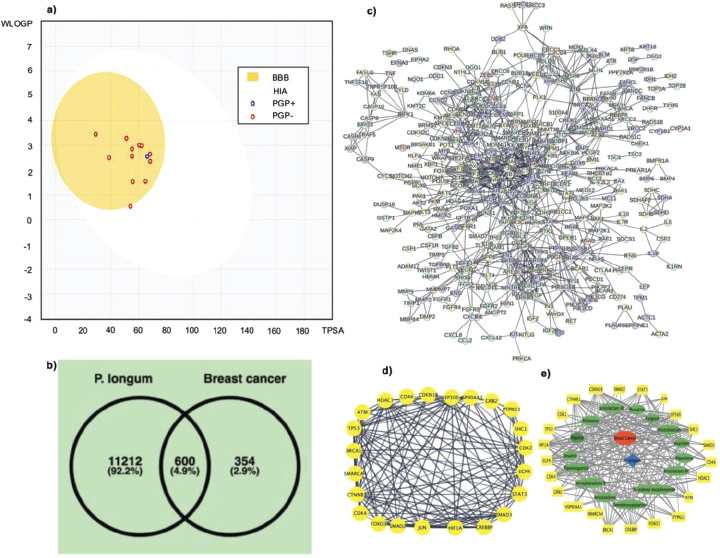
Results: This study revealed 600 common gene targets between P. longum compounds and breast cancer. Compound-target-disease network analysis prioritized Norcepharadione B, Aristolodione, Pellitorine, Aristolactam AII, and N-isobutyl decadienamide as candidate compounds. Significant breast cancer genes (TP53, CTNNB1, STAT3, SMAD3, EGFR, and HSP90AA1) were central to these interactions. Notably, HSP90AA1 showed the most favorable predicted docking scores with Norcepharadione B and Aristolactam AII. Additionally, the aqueous extract of P. longum significantly inhibited the MCF-7 MTT signal, with an IC50 of 3.75 μg/mL.
Conclusion and Implications for Translation: In this study, Piper longum phytochemicals were linked to key cancer genes. Molecular docking of the top five compounds with six genes showed that Norcepharadione B had the strongest affinity for HSP90AA1, indicating its potential to modulate HSP90AA1-mediated pathways, including ER and HER2 signaling. These interactions suggest therapeutic relevance. Furthermore, aqueous P. longum extract inhibited MCF-7 cellular metabolism at the IC₅₀ dose, possibly through cell-cycle arrest or apoptosis, which is currently under further investigation in our laboratory. These findings support further testing of defined P. longum compounds in breast-cancer models, but they do not yet establish therapeutic activity or mechanism.
Downloads
Similar Articles
- Iddi Matovu, Miph Musoke, HIV Infection Among Adolescent Girls and Young Women in Sub-Saharan Africa: Philosophical Perspectives of Sociostructural Risk Factors , Vol. 8 No. Continuous (2024): The International Journal of Translational Medical Research and Public Health (IJTMRPH)
- Selina Khatun, Rafiqul Islam, Nazrul Islam Mondal, Nazrul Hoque, Clyde McNeil, Fatema Siddiqua, Sociodemographic Determinants of Early, Normal, and Delayed Menarche among Female College-Aged Students in Bangladesh , Vol. 1 No. 1 (2017): The International Journal of Translational Medical Research and Public Health (IJTMRPH)
- Musa M Dogara, Saadatu Ahmad, Babalola J Balogun, Salwa S Dawaki, Muzammil B Mustapha, Aminu U Abdurrahman, Lawal Bala, Abubakar Zakari, David U Livingstone, Schistosomiasis and Associated Risk Factors Among School-Aged Children in Northern Nigeria , Vol. 4 No. 2 (2020): The International Journal of Translational Medical Research and Public Health (IJTMRPH)
- Elizabeth Armstrong-Mensah , Niha Mitha, Aireona McNair, The Mental Health of Syrian Refugees in the United States: Examining Critical Risk Factors and Major Barriers to Mental Health Care Access , Vol. 7 No. 1 (2023): The International Journal of Translational Medical Research and Public Health (IJTMRPH)
- Fazal Dad, Tafara Ndumiyana, Aweke Kebede, Blessing Butaumocho, Anthony Muganza, Robert Ackatia Armah, Lidya Mitike, Mella Taban, Strengthening Rural Food Systems through the UN World Food Program’s Fresh Food Voucher in Ethiopia’s Somali Region: An Evaluation of Nutritional and Market Impacts , Vol. 10 (2026): The International Journal of Translational Medical Research and Public Health (IJTMRPH)
- Gopal K. Singh, Hyunjung Lee, Lyoung Hee Kim, Gem P Daus, Promoting Health Literacy as an Important Initiative in Reducing Health Disparities and Advancing Health Equity , Vol. 8 No. Continuous (2024): The International Journal of Translational Medical Research and Public Health (IJTMRPH)
- Gopal K Singh, Hyunjung Lee, Gem P Daus, Prevalence and Sociodemographic and Behavioral Correlates of Psychological Distress among Lesbian, Gay, and Bisexual Adults in the United States, 2013-2018 , Vol. 6 No. 1 (2022): The International Journal of Translational Medical Research and Public Health (IJTMRPH)
- Tukur Dahiru, Awawu G Nmadu, Adegboyega M Oyefabi, Clement Woje, Bilkisu Nwankwo, Zainab K Muhammad-Idris, Levels, Trends, and Causes of Adolescent and Young Adult Maternal Mortality in Nigeria During 1990–2017: Analysis of the 2017 Global Burden of Disease Study Database , Vol. 6 No. 2 (2022): The International Journal of Translational Medical Research and Public Health (IJTMRPH)
- Mohamed Rida Tagajdid, Safae Elkochri, Hicham Elannaz, Rachid Abi, Idriss Lahlou Amine, Epidemiological, Clinical and Virological Characteristics of Patients with Hepatitis C in Morocco , Vol. 4 No. 1 (2020): The International Journal of Translational Medical Research and Public Health (IJTMRPH)
- Hyunjung Lee, Gopal K Singh, Racial and Ethnic Disparities in the Mental Health Impact of the COVID-19 Pandemic in the United States: Analysis of 3 Million Americans from the National Health Interview Survey and Household Pulse Survey , Vol. 6 No. 2 (2022): The International Journal of Translational Medical Research and Public Health (IJTMRPH)
You may also start an advanced similarity search for this article.
Published
How to Cite
Issue
Section
License
Copyright © 2026 Shivam Singh, Ashok Sharma, Richa Tripathi, Vitthal Govindappa Huddar, Subhash Gupta. Published by Global Health and Education Projects, Inc., USA.

This is an open-access article distributed under the terms of the Creative Commons Attribution-NonCommercial-ShareAlike 4.0 International License , which permits others to remix, transform, and build upon the work non-commercially, provided the original author is credited and the new creations are licensed under the same terms.



 .
.

