
Diagnosis of Sickle Cell Disease in Gabon Using Sickle SCAN®: A Point-of-Care Blood Test
DOI:
https://doi.org/10.21106/ijtmrph.315Keywords:
- Sickle Cell Disease,
- Phenotypic Diagnosis,
- Sickle SCAN®,
- Capillary Electrophoresis,
- Gabon
Abstract
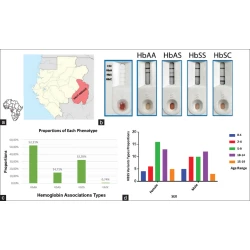
Background: Sickle cell disease (SCD) is the world’s most common genetic blood disorder. Most infant deaths from SCD occur in sub-Saharan Africa, and the mortality rate is exceptionally high in Gabon in Central Africa. In Gabon, there are limited resources for early and accurate detection of sickle cell or trait conditions. Most affected individuals reside in low-resource areas where access to diagnostic testing is often very limited. The most commonly used diagnostic methods require trained staff, adequate infrastructure, electric power, and enough time to perform the analysis. These requirements do not currently allow mass screening to be performed in remote areas of Gabon. The purpose of this pilot study is to develop a standardized screening procedure for SCD in order to determine its prevalence in the southeast area of Gabon by using a rapid and reliable test that does not require significant resources, such as the Sickle SCAN® device. Methods: The accuracy of the Sickle SCAN® device was assessed based on testing 272 blood samples. The exact hemoglobin was identified in 100% of the samples. The test comprises three proprietary indicators that detect the presence of hemoglobin A, S, and C, thus allowing the user to rapidly distinguish between normal (HbAA, N=142), carrier (HbAS, N=41), and sickle cell disease (HbSS, N=88; HbSC, N=1) samples. Hemoglobin variants (S and C) were confirmed by capillary electrophoresis (MinicapR; Sebia). The sensitivity and specificity were calculated for each phenotype. Results: The Sickle SCAN® test analysis revealed the following normal and abnormal phenotypes, including sickle cell trait (HbAS=14,71%) and SCD [HbSS (32.35%) and HbSC (0,74)]. There are no false positives in Sickle SCAN® result for the presence of hemoglobin variant, compared to gold standard approaches to capillary electrophoresis. The estimated sensitivity of the Sickle Scan® test was 92.2%, 100%, and 100% for HbSS, HbAS, and HbSC, respectively. The specificity exceeded 88.23% for all phenotypes (HbSS, HbAS, and HbSC). Conclusion and Implications for Translation:The Sickle Scan® device was found to be reliable with a sensitivity of 92.2%, 100%, and 100% for HbSS, HbAS, and HbSC, respectively. The specificity exceeded 88% for all phenotypes.
Downloads
Similar Articles
- Gopal K Singh, Hyunjung Lee, Romuladus E Azuine, Food Insecurity among Lesbian, Gay, Bisexual, and Transgender Adults During the COVID-19 Pandemic in the United States, July-October 2021 , Vol. 6 No. 1 (2022): The International Journal of Translational Medical Research and Public Health (IJTMRPH)
- Deepa Dongarwar, Brisa Y Garcia, Sitratullah O Maiyegun, Korede K Yusuf, Hamisu M Salihu, COVID-19 Early Vaccination Rates and Gross Domestic Product Per Capita , Vol. 5 No. 1 (2021): The International Journal of Translational Medical Research and Public Health (IJTMRPH)
- Hamisu M Salihu, Brisa Y Garcia, Deepa Dongarwar, Racial/Ethnic Disparities in Receipt of Lung Transplant and In-Hospital Mortality among Pediatric and Adolescent Patients in the United States , Vol. 5 No. 2 (2021): The International Journal of Translational Medical Research and Public Health (IJTMRPH)
- Comfort Z Olorunsaiye, Hannah M Degge, Jiana Saigh, Association Between Source of Treatment and Quality of Childhood Diarrhea Management Among Under-Five Children in Nigeria , Vol. 5 No. 2 (2021): The International Journal of Translational Medical Research and Public Health (IJTMRPH)
- Albert Apotele Nyaaba, Augustine Tanle, Louis Kobina Dadzie, Matthew Ayamga, Determinants of Under-Five Mortality in Ghana: Evidence from the Ghana Demographic and Health Survey , Vol. 4 No. 2 (2020): The International Journal of Translational Medical Research and Public Health (IJTMRPH)
- Romuladus E Azuine, Gopal K Singh, Shanita D Williams, Evangeline T Oparaocha, Shiv C Mathur, Translating Public and Population Health Research into Policy and Actions: The International Journal of Translational Medical Research and Public Health (IJTMRPH) , Vol. 1 No. 1 (2017): The International Journal of Translational Medical Research and Public Health (IJTMRPH)
- Selina Khatun, Rafiqul Islam, Nazrul Islam Mondal, Nazrul Hoque, Clyde McNeil, Fatema Siddiqua, Sociodemographic Determinants of Early, Normal, and Delayed Menarche among Female College-Aged Students in Bangladesh , Vol. 1 No. 1 (2017): The International Journal of Translational Medical Research and Public Health (IJTMRPH)
- Akinwale Johnson Ogundipe, Barry Okoro, Charles Igbokwe, Kyriakos Kouveliotis, Eseoghene Fredrick Arigbe, David Akpan, Jimin Sontyo, Elijah Idoko, Care Plan as an Effective Service Tool to Improving Well-being of Vulnerable Households: A Case Study of Lagos and Calabar, Nigeria , Vol. 10 (2026): The International Journal of Translational Medical Research and Public Health (IJTMRPH)
- Elizabeth Afibah Armstrong-Mensah, Ato Kwamena Tetteh, HIV Prevention in sub-Saharan Africa: Where Are Adolescents in the Continuum? , Vol. 5 No. 2 (2021): The International Journal of Translational Medical Research and Public Health (IJTMRPH)
- Maureen Atieno Adoyo, Yeri M Kombe, Gestational Diabetes Mellitus and Associated Health Risk Outcomes in Mothers and Neonates , Vol. 4 No. 1 (2020): The International Journal of Translational Medical Research and Public Health (IJTMRPH)
<< < 5 6 7 8 9 10 11 12 13 > >>
You may also start an advanced similarity search for this article.
Published
How to Cite
Issue
Section
License
Copyright © 2022 Lucrèce M Delicat-Loembet, A.D. Nno Mabiala, Ulrich Bisvigou, Eveline Avoune, Solange Bongo, André N’Tchoreret, Arnaud Kouoyo, Alain Ondo, Alexis E Dokekias, Jean Koko, Simon Ategbo. Published by Global Health and Education Projects, Inc., USA.

This is an open-access article distributed under the terms of the Creative Commons Attribution-NonCommercial-ShareAlike 4.0 International License , which permits others to remix, transform, and build upon the work non-commercially, provided the original author is credited and the new creations are licensed under the same terms.



 .
.

