
Diagnosis of Sickle Cell Disease in Gabon Using Sickle SCAN®: A Point-of-Care Blood Test
DOI:
https://doi.org/10.21106/ijtmrph.315Keywords:
- Sickle Cell Disease,
- Phenotypic Diagnosis,
- Sickle SCAN®,
- Capillary Electrophoresis,
- Gabon
Abstract
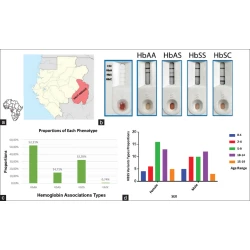
Background: Sickle cell disease (SCD) is the world’s most common genetic blood disorder. Most infant deaths from SCD occur in sub-Saharan Africa, and the mortality rate is exceptionally high in Gabon in Central Africa. In Gabon, there are limited resources for early and accurate detection of sickle cell or trait conditions. Most affected individuals reside in low-resource areas where access to diagnostic testing is often very limited. The most commonly used diagnostic methods require trained staff, adequate infrastructure, electric power, and enough time to perform the analysis. These requirements do not currently allow mass screening to be performed in remote areas of Gabon. The purpose of this pilot study is to develop a standardized screening procedure for SCD in order to determine its prevalence in the southeast area of Gabon by using a rapid and reliable test that does not require significant resources, such as the Sickle SCAN® device. Methods: The accuracy of the Sickle SCAN® device was assessed based on testing 272 blood samples. The exact hemoglobin was identified in 100% of the samples. The test comprises three proprietary indicators that detect the presence of hemoglobin A, S, and C, thus allowing the user to rapidly distinguish between normal (HbAA, N=142), carrier (HbAS, N=41), and sickle cell disease (HbSS, N=88; HbSC, N=1) samples. Hemoglobin variants (S and C) were confirmed by capillary electrophoresis (MinicapR; Sebia). The sensitivity and specificity were calculated for each phenotype. Results: The Sickle SCAN® test analysis revealed the following normal and abnormal phenotypes, including sickle cell trait (HbAS=14,71%) and SCD [HbSS (32.35%) and HbSC (0,74)]. There are no false positives in Sickle SCAN® result for the presence of hemoglobin variant, compared to gold standard approaches to capillary electrophoresis. The estimated sensitivity of the Sickle Scan® test was 92.2%, 100%, and 100% for HbSS, HbAS, and HbSC, respectively. The specificity exceeded 88.23% for all phenotypes (HbSS, HbAS, and HbSC). Conclusion and Implications for Translation:The Sickle Scan® device was found to be reliable with a sensitivity of 92.2%, 100%, and 100% for HbSS, HbAS, and HbSC, respectively. The specificity exceeded 88% for all phenotypes.
Downloads
Similar Articles
- Johnny Rice II, Mercy N. Shenge, Environmental Justice and Environmental Crime Awareness at Historically Black Colleges and Universities (HBCUs): Insights from Behavioral Science Researchers , Vol. 10 (2026): The International Journal of Translational Medical Research and Public Health (IJTMRPH)
- Hyunjung Lee, Gopal K Singh, Racial and Ethnic Disparities in the Mental Health Impact of the COVID-19 Pandemic in the United States: Analysis of 3 Million Americans from the National Health Interview Survey and Household Pulse Survey , Vol. 6 No. 2 (2022): The International Journal of Translational Medical Research and Public Health (IJTMRPH)
- Harlem J Gunness, Striking Differences in Physical and Mental/Behavioral Health Status Between Homeless Bisexual and Gay Young Men in New York City, United States , Vol. 4 No. 1 (2020): The International Journal of Translational Medical Research and Public Health (IJTMRPH)
- Matiur Rahman, Kaoser Bin Siddique, Mohammad Mahbub Ur Rahim, Cancer Registry in Bangladesh: Challenges and Opportunities , Vol. 8 No. Continuous (2024): The International Journal of Translational Medical Research and Public Health (IJTMRPH)
- Sergio Navarro, Kelsey Stewart, Katelyn M Tessier, Aemon Berhane, Susana Prestinary Alvarado, Tavonga Tafirei, Hodan Abdi, Evan J Keil, Todd Tuttle, Jennifer Rickard, Medical Students’ Perceptions of Clinical and Research Training: An International Needs Assessment of 26 Countries , Vol. 7 No. 2 (2023): The International Journal of Translational Medical Research and Public Health (IJTMRPH)
- Elizabeth Armstrong-Mensah , Niha Mitha, Aireona McNair, The Mental Health of Syrian Refugees in the United States: Examining Critical Risk Factors and Major Barriers to Mental Health Care Access , Vol. 7 No. 1 (2023): The International Journal of Translational Medical Research and Public Health (IJTMRPH)
- Gopal K Singh, Hyunjung Lee, Romuladus E Azuine, Increasing Trends in Physical and Mental Health Problems among US Workers in Different Job Sectors During the COVID-19 Pandemic , Vol. 5 No. 2 (2021): The International Journal of Translational Medical Research and Public Health (IJTMRPH)
- Gopal K Singh, Hyunjung Lee, Romuladus E Azuine, Marked Inequalities in COVID-19 Vaccination by Racial/Ethnic, Socioeconomic, Geographic, and Health Characteristics, United States, January 6 – February 15, 2021 , Vol. 5 No. 2 (2021): The International Journal of Translational Medical Research and Public Health (IJTMRPH)
- Deepa Dongarwar, Hamisu M Salihu, COVID-19 Vaccination Rates by Global Universal Health Care Coverage Status , Vol. 5 No. 1 (2021): The International Journal of Translational Medical Research and Public Health (IJTMRPH)
- Gonzalo Monge, Matías Otto-Yáñez, Nicole Norambuena, Verónica Martínez, Daniela Retamales, Rodrigo Torres-Castro, Safety of Hyperbaric Oxygenation Treatment and Evaluation of Associated Clinical Parameters: A Single-Institutional Prospective Cohort Study , Vol. 7 No. 1 (2023): The International Journal of Translational Medical Research and Public Health (IJTMRPH)
<< < 2 3 4 5 6 7 8 9 10 11 > >>
You may also start an advanced similarity search for this article.
Published
How to Cite
Issue
Section
License
Copyright © 2022 Lucrèce M Delicat-Loembet, A.D. Nno Mabiala, Ulrich Bisvigou, Eveline Avoune, Solange Bongo, André N’Tchoreret, Arnaud Kouoyo, Alain Ondo, Alexis E Dokekias, Jean Koko, Simon Ategbo. Published by Global Health and Education Projects, Inc., USA.

This is an open-access article distributed under the terms of the Creative Commons Attribution-NonCommercial-ShareAlike 4.0 International License , which permits others to remix, transform, and build upon the work non-commercially, provided the original author is credited and the new creations are licensed under the same terms.



 .
.

