
Marked Disparities in COVID-19 Prevalence by Racial/Ethnic, Socioeconomic, Geographic, and Health Care Characteristics, United States, January – April, 2021
DOI:
https://doi.org/10.21106/ijtmrph.345Keywords:
- COVID-19,
- Social Determinants,
- Prevalence,
- Race,
- Socioeconomic Status,
- Metropolitan,
- Disparities,
- Job Loss
Abstract
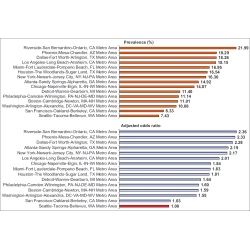
Background: Since the start of the coronavirus disease (COVID-19) pandemic in March 2020, racial/ ethnic minorities and socially-disadvantaged populations in the United States (US) have experienced disproportionately higher rates of COVID-19 incidence, mortality and hospitalization. However, the extent of disparities in the prevalence of COVID-19 diagnosis have not been well-documented. Using nationally representative data, this study examines racial/ethnic, socioeconomic, and geographic inequalities in COVID-19 prevalence among US adults aged ≥18 years. Methods: Using the Census Bureau’s Household Pulse Survey from January 6-April 26, 2021 (N=521,203), social inequalities in COVID-19 prevalence were analyzed by multivariate logistic regression. Results: During January-April 2021, 34.7 million or 14.2% of US adults reported ever being diagnosed with COVID-19. Those aged 18-24 and 45-54 were two times more likely to be diagnosed with COVID-19 than those aged ≥75. Disease prevalence ranged from 10.0% for Asians to 14.2% for Black/African Americans and 23.0% for Hispanics. Controlling for covariates, non-Hispanic Whites, Black/African Americans, and Hispanics had, respectively, 23%, 31%, and 134% higher odds of being diagnosed with COVID-19 than Asians. Educational gradients were marked; adults with less than a high school education had twice the prevalence of COVID-19 than those with a graduate degree (19.0% vs. 9.4%). Controlling for covariates, those with less than high school and high school education had, respectively, 66% and 48% higher odds of being diagnosed with COVID-19 than those with a graduate degree. Those experiencing job/income losses during the pandemic had a significantly increased risk of COVID-19 diagnosis, adjusting for other factors. Prevalence of COVID-19 ranged from a low of 7.4% in Seattle-Tacoma Metropolitan Statistical Area (MSA) to a high of 30.0% in Riverside-San Bernardino MSA. Conclusions and Implications for Translational Research: Black/African Americans, Hispanics, NonHispanic Whites, socially-disadvantaged adults, and those living in Riverside-San Bernardino, Phoenix, Dallas-Fort Worth, and Los Angeles-Long Beach MSAs had substantially higher likelihood of being diagnosed with COVID-19.
Downloads
Most read articles by the same author(s)
- Mehrete Girmay, Gopal K Singh, Social Isolation, Loneliness, and Mental and Emotional Well-being among International Students in the United States , International Journal of Translational Medical Research and Public Health: Vol. 3 No. 2 (2019): The International Journal of Translational Medical Research and Public Health (IJTMRPH)
- Hyunjung Lee, Gopal K Singh, Racial and Ethnic Disparities in the Mental Health Impact of the COVID-19 Pandemic in the United States: Analysis of 3 Million Americans from the National Health Interview Survey and Household Pulse Survey , International Journal of Translational Medical Research and Public Health: Vol. 6 No. 2 (2022): The International Journal of Translational Medical Research and Public Health (IJTMRPH)
- Gopal K Singh, Shanita D Williams, Hyunjung Lee, Elijah K Martin, Michelle Allender, Christine T Ramey, Trends in Physical and Mental Health, Mortality, Life Expectancy, and Social Inequalities Among American Indians and Alaska Natives, 1990-2019 , International Journal of Translational Medical Research and Public Health: Vol. 5 No. 2 (2021): The International Journal of Translational Medical Research and Public Health (IJTMRPH)
- Romuladus E Azuine, Gopal K Singh, Shanita D Williams, Evangeline T Oparaocha, Shiv C Mathur, Translating Public and Population Health Research into Policy and Actions: The International Journal of Translational Medical Research and Public Health (IJTMRPH) , International Journal of Translational Medical Research and Public Health: Vol. 1 No. 1 (2017): The International Journal of Translational Medical Research and Public Health (IJTMRPH)
- Gopal K. Singh, Hyunjung Lee, Romuladus E. Azuine, Trends and Socioeconomic, Demographic, and Behavioral Determinants of Kidney Disease Prevalence among African Americans in the United States, 1997–2021 , International Journal of Translational Medical Research and Public Health: Vol. 9 No. Continuous (2025): The International Journal of Translational Medical Research and Public Health (IJTMRPH)
- Gopal K. Singh, Hyunjung Lee, Lyoung Hee Kim, Gem P Daus, Promoting Health Literacy as an Important Initiative in Reducing Health Disparities and Advancing Health Equity , International Journal of Translational Medical Research and Public Health: Vol. 8 No. Continuous (2024): The International Journal of Translational Medical Research and Public Health (IJTMRPH)
- Gopal K Singh, Mehrete Girmay, Michelle Allender, Christine T Ramey, Digital Divide: Marked Disparities in Computer and Broadband Internet Use and Associated Health Inequalities in the United States , International Journal of Translational Medical Research and Public Health: Vol. 4 No. 1 (2020): The International Journal of Translational Medical Research and Public Health (IJTMRPH)
- Gopal K Singh, Hyunjung Lee, Romuladus E Azuine, Food Insecurity among Lesbian, Gay, Bisexual, and Transgender Adults During the COVID-19 Pandemic in the United States, July-October 2021 , International Journal of Translational Medical Research and Public Health: Vol. 6 No. 1 (2022): The International Journal of Translational Medical Research and Public Health (IJTMRPH)
- Gopal K. Singh, Lyoung Hee Kim, Hyunjung Lee, Romuladus E Azuine, Disparities in Prevalence of COVID-19, Long COVID, Disease Severity, and Mental Health Outcomes among US Adults by Industrial Sector of Employment, September-November 2022 , International Journal of Translational Medical Research and Public Health: Vol. 7 No. 2 (2023): The International Journal of Translational Medical Research and Public Health (IJTMRPH)
- Hyunjung Lee, Gopal K Singh, Marked Disparities in Cardiovascular Disease Mortality by Levels of Happiness and Life Satisfaction in the United States , International Journal of Translational Medical Research and Public Health: Vol. 4 No. 2 (2020): The International Journal of Translational Medical Research and Public Health (IJTMRPH)
Similar Articles
- Chinyelu O Mba, Ransom B Jacob, Mercy B Green, Loveday U Zebedee, Hematological Profile of Pregnant Women in Port Harcourt, Nigeria , Vol. 3 No. 1 (2019): The International Journal of Translational Medical Research and Public Health (IJTMRPH)
- Michael Quinn Patton, Laura Elisabeth Gressler, Sustainable, Cooperative, Inclusive, Organized Networks, and Translational Health: A Book Review of Saving Societies from Within: Innovation and Equity through Inter-Organizational Networks , Vol. 9 No. Special Collection (2025): The International Journal of Translational Medical Research and Public Health (IJTMRPH)
- María G Ramírez-Rojas, María G Freyermuth-Enciso, María B Duarte-Gómez, Defragmenting the Health Care System in Mexico: Universal Access for Obstetric Emergencies , Vol. 4 No. 1 (2020): The International Journal of Translational Medical Research and Public Health (IJTMRPH)
- Deepa Dongarwar, Karla Moriel, Kobby A Wiafe, Hamisu M Salihu, Sex and Age-Based Differences in Adult Acute Myeloid Leukemia Hospitalizations in the United States, 2009-2018 , Vol. 6 No. 1 (2022): The International Journal of Translational Medical Research and Public Health (IJTMRPH)
- Elisa J. Gordon, Zubairu Iliyasu, Elizabeth S. Rose, Fatimah I. Tsiga-Ahmed, Usman J. Wudil, Aishatu L. Adamu, C. William Wester, Muktar H. Aliyu, Building Capacity for the Ethical Conduct of Genetic and Genomic Research in Nigeria: The Vanderbilt-Nigeria Research Ethics Training Program , Vol. 9 No. Continuous (2025): The International Journal of Translational Medical Research and Public Health (IJTMRPH)
- Akshaya S Bhagavathula, AI-Enhanced Epidemiology Education: Bridging Technology and Conceptual Understanding , Vol. 8 No. Continuous (2024): The International Journal of Translational Medical Research and Public Health (IJTMRPH)
- John A Markson, Early Infant Diagnosis of HIV in Primary Health Care Centers , Vol. 5 No. 1 (2021): The International Journal of Translational Medical Research and Public Health (IJTMRPH)
- Christopher S Oyamienlen, Charles A Adisa, Ikechukwu N. S Dozie, Evangeline T Oparaocha, Angelica A Anele, Kingsley C Anochiwa, Body Mass Index and Breast Cancer Risks Among Igbo Women in Imo and Abia States, Nigeria: A Case Control Study , Vol. 3 No. 1 (2019): The International Journal of Translational Medical Research and Public Health (IJTMRPH)
- Romuladus E. Azuine, Gopal K. Singh, Rowena C. Saplala, The Journey So Far: Welcoming Our New Editor and Journal Progress Report , Vol. 9 No. Special Collection (2025): The International Journal of Translational Medical Research and Public Health (IJTMRPH)
- Gonzalo Monge, Matías Otto-Yáñez, Nicole Norambuena, Verónica Martínez, Daniela Retamales, Rodrigo Torres-Castro, Safety of Hyperbaric Oxygenation Treatment and Evaluation of Associated Clinical Parameters: A Single-Institutional Prospective Cohort Study , Vol. 7 No. 1 (2023): The International Journal of Translational Medical Research and Public Health (IJTMRPH)
<< < 8 9 10 11 12 13 14 15 > >>
You may also start an advanced similarity search for this article.
Published
How to Cite
Issue
Section
License
Copyright © 2021 Gopal K Singh, Hyunjung Lee. Published by Global Health and Education Projects, Inc., USA.

This is an open-access article distributed under the terms of the Creative Commons Attribution-NonCommercial-ShareAlike 4.0 International License , which permits others to remix, transform, and build upon the work non-commercially, provided the original author is credited and the new creations are licensed under the same terms.



 .
.

