
Estimating Contributions of Social and Behavioral Factors to Cardiovascular Disease, Cancer, COPD, and Unintentional-Injury Mortality Disparities by Psychological Distress in the United States: A Blinder-Oaxaca Decomposition Analysis of the 1997-2014 NHIS
DOI:
https://doi.org/10.21106/ijtmrph.403Keywords:
- Psychological Distress,
- Socioeconomic Status,
- Health Behaviors,
- Cause of Death,
- Cancer,
- CVD,
- COPD,
- Injury,
- Blinder-Oaxaca Decomposition,
- Longitudinal
Abstract
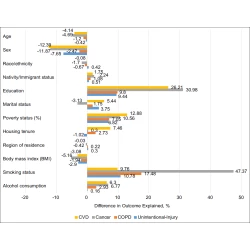
Background: Previous research has shown a significant association between psychological distress (PD) and cause-specific mortality, but contributions of sociodemographic and behavioral characteristics to mortality differences by PD are not fully explored. Methods: The Blinder-Oaxaca decomposition analysis was used to quantify the contributions of individual sociodemographic and behavioral characteristics to the observed cardiovascular disease (CVD), cancer, chronic obstructive pulmonary disease (COPD), and unintentional-injury mortality disparities between United States (US) adults with no PD and those with serious psychological distress (SPD), using the pooled 1997-2014 data from the National Health Interview Survey prospectively linked to the National Death Index (N=263,825). Results: Lower levels of education and household income, and higher proportions of current smokers, former drinkers, non-married adults, US-born, and renters contributed to higher mortality for adults with SPD. The relative percentage of mortality explained by sociodemographic and behavioral factors was highest for cancer mortality (71.25%) and lowest for unintentional-injury mortality (20.19%). Enhancing education level among adults with SPD would decrease approximately 30% of cancer or CVD mortality disparity, and around 10% of COPD and unintentional-injury mortality disparities. Half of the cancer mortality disparity (47.4%) could be attributed to a single factor, smoking. Increasing income level will decrease 7 to 13% of the disparity in cause-specific mortality. Higher proportions of renters explained higher CVD and COPD mortality among adults with SPD by 7% and 3%, respectively. Higher proportions of former drinkers explained higher CVD, cancer, and COPD mortality among adults with SPD by 6%, 7%, and 3%, respectively. Younger age, higher proportion of females, and higher BMI among adults with SPD mitigated the mortality disparities. Conclusion and Implications for Translation: Improved education and income levels, and reduced smoking among US adults with SPD would eliminate around 90% of the cancer mortality disparity by SPD, and half of the CVD mortality disparity.
Downloads
Most read articles by the same author(s)
- Mehrete Girmay, Gopal K Singh, Social Isolation, Loneliness, and Mental and Emotional Well-being among International Students in the United States , International Journal of Translational Medical Research and Public Health: Vol. 3 No. 2 (2019): The International Journal of Translational Medical Research and Public Health (IJTMRPH)
- Hyunjung Lee, Gopal K Singh, Racial and Ethnic Disparities in the Mental Health Impact of the COVID-19 Pandemic in the United States: Analysis of 3 Million Americans from the National Health Interview Survey and Household Pulse Survey , International Journal of Translational Medical Research and Public Health: Vol. 6 No. 2 (2022): The International Journal of Translational Medical Research and Public Health (IJTMRPH)
- Gopal K Singh, Shanita D Williams, Hyunjung Lee, Elijah K Martin, Michelle Allender, Christine T Ramey, Trends in Physical and Mental Health, Mortality, Life Expectancy, and Social Inequalities Among American Indians and Alaska Natives, 1990-2019 , International Journal of Translational Medical Research and Public Health: Vol. 5 No. 2 (2021): The International Journal of Translational Medical Research and Public Health (IJTMRPH)
- Romuladus E Azuine, Gopal K Singh, Shanita D Williams, Evangeline T Oparaocha, Shiv C Mathur, Translating Public and Population Health Research into Policy and Actions: The International Journal of Translational Medical Research and Public Health (IJTMRPH) , International Journal of Translational Medical Research and Public Health: Vol. 1 No. 1 (2017): The International Journal of Translational Medical Research and Public Health (IJTMRPH)
- Gopal K. Singh, Hyunjung Lee, Romuladus E. Azuine, Trends and Socioeconomic, Demographic, and Behavioral Determinants of Kidney Disease Prevalence among African Americans in the United States, 1997–2021 , International Journal of Translational Medical Research and Public Health: Vol. 9 No. Continuous (2025): The International Journal of Translational Medical Research and Public Health (IJTMRPH)
- Gopal K. Singh, Hyunjung Lee, Lyoung Hee Kim, Gem P Daus, Promoting Health Literacy as an Important Initiative in Reducing Health Disparities and Advancing Health Equity , International Journal of Translational Medical Research and Public Health: Vol. 8 No. Continuous (2024): The International Journal of Translational Medical Research and Public Health (IJTMRPH)
- Gopal K Singh, Mehrete Girmay, Michelle Allender, Christine T Ramey, Digital Divide: Marked Disparities in Computer and Broadband Internet Use and Associated Health Inequalities in the United States , International Journal of Translational Medical Research and Public Health: Vol. 4 No. 1 (2020): The International Journal of Translational Medical Research and Public Health (IJTMRPH)
- Gopal K Singh, Hyunjung Lee, Romuladus E Azuine, Food Insecurity among Lesbian, Gay, Bisexual, and Transgender Adults During the COVID-19 Pandemic in the United States, July-October 2021 , International Journal of Translational Medical Research and Public Health: Vol. 6 No. 1 (2022): The International Journal of Translational Medical Research and Public Health (IJTMRPH)
- Gopal K. Singh, Lyoung Hee Kim, Hyunjung Lee, Romuladus E Azuine, Disparities in Prevalence of COVID-19, Long COVID, Disease Severity, and Mental Health Outcomes among US Adults by Industrial Sector of Employment, September-November 2022 , International Journal of Translational Medical Research and Public Health: Vol. 7 No. 2 (2023): The International Journal of Translational Medical Research and Public Health (IJTMRPH)
- Hyunjung Lee, Gopal K Singh, Marked Disparities in Cardiovascular Disease Mortality by Levels of Happiness and Life Satisfaction in the United States , International Journal of Translational Medical Research and Public Health: Vol. 4 No. 2 (2020): The International Journal of Translational Medical Research and Public Health (IJTMRPH)
Similar Articles
- Angelique B Willis, Mildred Addo, Lauren E Yoder, Cassandra K Johnson, Sydney L Resler, Leticia J Young, Elizabeth Armstrong-Mensah, Individual and Community Level Factors Related to Sanitation, Water Quality, Treatment and Management in Rural Communities in Accra, Ghana: A Field Study Report , Vol. 6 No. 1 (2022): The International Journal of Translational Medical Research and Public Health (IJTMRPH)
- Fatima Usman, Zubairu Iliyasu, Hamisu M Salihu, Muktar H Aliyu, COVID-19 Pandemic and Medical Education in Nigeria , Vol. 5 No. 2 (2021): The International Journal of Translational Medical Research and Public Health (IJTMRPH)
- Deepa Dongarwar, Brisa Y Garcia, Sitratullah O Maiyegun, Korede K Yusuf, Hamisu M Salihu, COVID-19 Early Vaccination Rates and Gross Domestic Product Per Capita , Vol. 5 No. 1 (2021): The International Journal of Translational Medical Research and Public Health (IJTMRPH)
- Laila Al Afnan, Enhancing Hepatitis B Awareness and Risk Management in Barbershops and Salons: A Call for Tailored Interventions , Vol. 8 No. Continuous (2024): The International Journal of Translational Medical Research and Public Health (IJTMRPH)
- Deepa Dongarwar, Karla Moriel, Kobby A Wiafe, Hamisu M Salihu, Sex and Age-Based Differences in Adult Acute Myeloid Leukemia Hospitalizations in the United States, 2009-2018 , Vol. 6 No. 1 (2022): The International Journal of Translational Medical Research and Public Health (IJTMRPH)
- Anayra Túa-López, Fabián Román, The Neuroscience of Social Exclusion: Developmental and Public Health Implications Across the Life-Course , Vol. 9 No. Continuous (2025): The International Journal of Translational Medical Research and Public Health (IJTMRPH)
- Ashok Bahadur Varma, Can the Internal Nasal Valves Method Be a Game Changer for Preventing Respiratory Tract Infections? , Vol. 8 No. Continuous (2024): The International Journal of Translational Medical Research and Public Health (IJTMRPH)
- Gonzalo Monge, Matías Otto-Yáñez, Nicole Norambuena, Verónica Martínez, Daniela Retamales, Rodrigo Torres-Castro, Safety of Hyperbaric Oxygenation Treatment and Evaluation of Associated Clinical Parameters: A Single-Institutional Prospective Cohort Study , Vol. 7 No. 1 (2023): The International Journal of Translational Medical Research and Public Health (IJTMRPH)
- Gordon Amadi, Samuel C Iwuji, Taofik O Azeez, Chidozie J Nwaokoro, Chioma O Wodu, Biochemical Effects of Piper Guineense (African Black Pepper) in Female Diabetics: Opportunities for Diabetes Treatment , Vol. 3 No. 1 (2019): The International Journal of Translational Medical Research and Public Health (IJTMRPH)
- Lucrèce M Delicat-Loembet, A.D. Nno Mabiala, Ulrich Bisvigou, Eveline Avoune, Solange Bongo, André N’Tchoreret, Arnaud Kouoyo, Alain Ondo, Alexis E Dokekias, Jean Koko, Simon Ategbo, Diagnosis of Sickle Cell Disease in Gabon Using Sickle SCAN®: A Point-of-Care Blood Test , Vol. 6 No. 2 (2022): The International Journal of Translational Medical Research and Public Health (IJTMRPH)
<< < 8 9 10 11 12 13 14 15 > >>
You may also start an advanced similarity search for this article.
Published
How to Cite
Issue
Section
License
Copyright © 2021 Hyunjung Lee, Gopal K Singh. Published by Global Health and Education Projects, Inc., USA.

This is an open-access article distributed under the terms of the Creative Commons Attribution-NonCommercial-ShareAlike 4.0 International License , which permits others to remix, transform, and build upon the work non-commercially, provided the original author is credited and the new creations are licensed under the same terms.



 .
.

