
Hypertension in Saudi Arabia: Assessing Life Style and Attitudes
DOI:
https://doi.org/10.21106/ijtmrph.112Keywords:
- DASH,
- Hypertension,
- Life Style,
- Knowledge,
- Saudi Arabia
Abstract
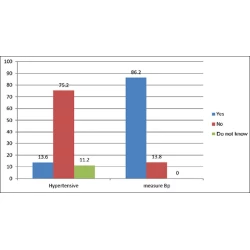
Background: The Dietary Approaches to Stop Hypertension (DASH) diet lowers blood pressure (BP) effectively. There is evidence that strongly supports the concept that lifestyle modification has a powerful effect on BP. The DASH diet includes increased physical activity, reduced salt intake, weight loss, increased potassium intake, and an overall healthy dietary pattern. This study assesses the knowledge and attitudes of Saudis in Riyadh City towards lifestyle and hypertension. Methods: A cross-sectional study was designed using a questionnaire-based assessment tool, which included sociodemographic data, knowledge and lifestyle attitudes toward hypertension, such as dietary factors, stress, smoking, physical activities, and diet-related diseases (including obesity and diabetes mellitus). Statistical analyses to examine the perceived association between lifestyle factors and hypertension risks included frequency distribution, percentages, and chi-square tests of significance. Results: Out of 934 total participants, 13.6% were hypertensive; 84.4% and 60.2% of participants believed eating salty food and fatty food, respectively, were risk factors for hypertension. Almost 66.0% of participants considered stress as a risk factor for the development of hypertension, whereas 77.0% considered smoking as a risk factor. The data showed that 87.5% considered obesity as a risk factor, and 73.8% considered reducing weight as a preventive measure for hypertension. Also, 68.8% believed that physical inactivity was a risk factor for hypertension. Data showed that 16.6 % ate vegetables and 23.1% ate fruits as recommended, whereas 18.8% and 18.4%, respectively, rarely ate vegetables and fruits. About 12.1% smoked and 19.7% exercised regularly, whereas 15.6% did not exercise at all. Traffic and examination were reported as stress factors by younger participants. Conclusion and Implications for Translation:The knowledge of the relationship between hypertension risk factors and eating salty or fatty food was high. In contrast, knowledge of not eating vegetables and fruits as a risk factor for the development of hypertension was very low among the Saudis.
Downloads
Similar Articles
- Peter Chilipweli, Given Mwambope, Abubakar O. Abdallah, Patrick Mwakubo, Aneth Dunia, Compliance, Barriers, and Enhancers of WHO “Five Moments for Hand Hygiene” Among Healthcare Workers in Tanzania , Vol. 9 No. Continuous (2025): The International Journal of Translational Medical Research and Public Health (IJTMRPH)
- Nsofwa Jubedah Mwansa, Victor Daka, David Mulenga, Ruth L Mfune, Bright Mukanga, Christopher Nyirenda, Seter Siziya, Correlates of Seizure Control Among Patients with Epilepsy at Two Referral Hospitals in Zambia , Vol. 4 No. 2 (2020): The International Journal of Translational Medical Research and Public Health (IJTMRPH)
- Caroline Mtaita, Samuel Likindikoki, Shishira Mnjokava, Gaspar Mbita, Elvis Safary, Dawud Hilliard, Albrecht Jahn, Accessibility to Gender-based Violence Health Services for Adolescent Girls and Young Women in Tanzania , Vol. 5 No. 2 (2021): The International Journal of Translational Medical Research and Public Health (IJTMRPH)
- Johnny Rice II, Mercy N. Shenge, Environmental Justice and Environmental Crime Awareness at Historically Black Colleges and Universities (HBCUs): Insights from Behavioral Science Researchers , Vol. 10 (2026): The International Journal of Translational Medical Research and Public Health (IJTMRPH)
- Gopal K Singh, Hyunjung Lee, Romuladus E Azuine, Growing Job-Related Income Losses, Increasing Social Inequalities, and Physical and Mental Health Impact During the COVID-19 Pandemic, United States, April – December 2020 , Vol. 5 No. 2 (2021): The International Journal of Translational Medical Research and Public Health (IJTMRPH)
- Elisa J. Gordon, Zubairu Iliyasu, Elizabeth S. Rose, Fatimah I. Tsiga-Ahmed, Usman J. Wudil, Aishatu L. Adamu, C. William Wester, Muktar H. Aliyu, Building Capacity for the Ethical Conduct of Genetic and Genomic Research in Nigeria: The Vanderbilt-Nigeria Research Ethics Training Program , Vol. 9 No. Continuous (2025): The International Journal of Translational Medical Research and Public Health (IJTMRPH)
- Gopal K Singh, Hyunjung Lee, Marked Disparities in COVID-19 Prevalence by Racial/Ethnic, Socioeconomic, Geographic, and Health Care Characteristics, United States, January – April, 2021 , Vol. 5 No. 2 (2021): The International Journal of Translational Medical Research and Public Health (IJTMRPH)
- Emmanuel Nwanya, Evangeline T Oparaocha, Book of Abstracts: 4th International Congress on Health Sciences and Technology Organized by the School of Health Technology, Federal University of Technology (FUTO), Owerri, Imo State, Nigeria, 7-9 August, 2019 , Vol. 3 No. S1 (2019): The International Journal of Translational Medical Research and Public Health (IJTMRPH)
- Arumugam Elangovan, Vasna Joshua, Aridoss Santhakumar, Balasubramanian Ganesh, Nagaraj Jaganathasamy, Joseph K David, Malathi Mathiyazhakan, Manikandan Natesan, VM Padmapriya, Pradeep Kumar, Identifying Risk Factors and Spatial Clustering of HIV Infection Among Female Sex Workers in India , Vol. 5 No. 1 (2021): The International Journal of Translational Medical Research and Public Health (IJTMRPH)
- Anayra Túa-López, Fabián Román, The Neuroscience of Social Exclusion: Developmental and Public Health Implications Across the Life-Course , Vol. 9 No. Continuous (2025): The International Journal of Translational Medical Research and Public Health (IJTMRPH)
<< < 1 2 3 4 5 6 7 8 9 10 > >>
You may also start an advanced similarity search for this article.
Published
How to Cite
Issue
Section
License
Copyright © 2020 Bushra Elbashir, Msab Al-dkheel, Hamad Aldakheel, Naif Aruwished, Nasser Alodayani. Published by Global Health and Education Projects, Inc., USA.

This is an open-access article distributed under the terms of the Creative Commons Attribution-NonCommercial-ShareAlike 4.0 International License , which permits others to remix, transform, and build upon the work non-commercially, provided the original author is credited and the new creations are licensed under the same terms.



 .
.

