
Hypertension in Saudi Arabia: Assessing Life Style and Attitudes
DOI:
https://doi.org/10.21106/ijtmrph.112Keywords:
- DASH,
- Hypertension,
- Life Style,
- Knowledge,
- Saudi Arabia
Abstract
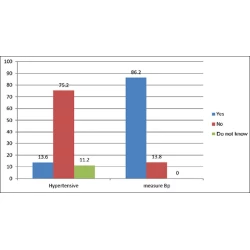
Background: The Dietary Approaches to Stop Hypertension (DASH) diet lowers blood pressure (BP) effectively. There is evidence that strongly supports the concept that lifestyle modification has a powerful effect on BP. The DASH diet includes increased physical activity, reduced salt intake, weight loss, increased potassium intake, and an overall healthy dietary pattern. This study assesses the knowledge and attitudes of Saudis in Riyadh City towards lifestyle and hypertension. Methods: A cross-sectional study was designed using a questionnaire-based assessment tool, which included sociodemographic data, knowledge and lifestyle attitudes toward hypertension, such as dietary factors, stress, smoking, physical activities, and diet-related diseases (including obesity and diabetes mellitus). Statistical analyses to examine the perceived association between lifestyle factors and hypertension risks included frequency distribution, percentages, and chi-square tests of significance. Results: Out of 934 total participants, 13.6% were hypertensive; 84.4% and 60.2% of participants believed eating salty food and fatty food, respectively, were risk factors for hypertension. Almost 66.0% of participants considered stress as a risk factor for the development of hypertension, whereas 77.0% considered smoking as a risk factor. The data showed that 87.5% considered obesity as a risk factor, and 73.8% considered reducing weight as a preventive measure for hypertension. Also, 68.8% believed that physical inactivity was a risk factor for hypertension. Data showed that 16.6 % ate vegetables and 23.1% ate fruits as recommended, whereas 18.8% and 18.4%, respectively, rarely ate vegetables and fruits. About 12.1% smoked and 19.7% exercised regularly, whereas 15.6% did not exercise at all. Traffic and examination were reported as stress factors by younger participants. Conclusion and Implications for Translation:The knowledge of the relationship between hypertension risk factors and eating salty or fatty food was high. In contrast, knowledge of not eating vegetables and fruits as a risk factor for the development of hypertension was very low among the Saudis.
Downloads
Similar Articles
- Laura Elisabeth Gressler, Andrej Radoja, Terrie Cowley, Deanne Clare, John Kusiak, Allen Cowley, Temporomandibular Disorders at a Crossroads: Meeting Summary , Vol. 9 No. Special Collection (2025): The International Journal of Translational Medical Research and Public Health (IJTMRPH)
- Muktar H Aliyu, Mahmoud U Sani, Donna J Ingles, Fatima I. T siga-Ahmed, Baba M Musa, M. Shannon Byers, Deepa Dongarwar, Hamisu M Salihu, C. William Wester, Building Physician-Scientist Skills in R Programming: A Short Workshop Report , Vol. 6 No. 1 (2022): The International Journal of Translational Medical Research and Public Health (IJTMRPH)
- Sergio Navarro, Kelsey Stewart, Katelyn M Tessier, Aemon Berhane, Susana Prestinary Alvarado, Tavonga Tafirei, Hodan Abdi, Evan J Keil, Todd Tuttle, Jennifer Rickard, Medical Students’ Perceptions of Clinical and Research Training: An International Needs Assessment of 26 Countries , Vol. 7 No. 2 (2023): The International Journal of Translational Medical Research and Public Health (IJTMRPH)
- Gopal K Singh, Mehrete Girmay, Michelle Allender, Christine T Ramey, Digital Divide: Marked Disparities in Computer and Broadband Internet Use and Associated Health Inequalities in the United States , Vol. 4 No. 1 (2020): The International Journal of Translational Medical Research and Public Health (IJTMRPH)
- Ogechukwu B Aribodor, Chinyelu A Ekwunife, Olufemi S Sam-Wobo, Dennis N Aribodor, Risk Factors and Socio-demographic Determinants of Intestinal Helminthiasis among Children in Schools that Implemented the Homegrown School Feeding Program in Ekwulobia, Anambra State, Southeast Nigeria , Vol. 2 No. 1 (2018): The International Journal of Translational Medical Research and Public Health (IJTMRPH)
- Iddi Matovu, Miph Musoke, HIV Infection Among Adolescent Girls and Young Women in Sub-Saharan Africa: Philosophical Perspectives of Sociostructural Risk Factors , Vol. 8 No. Continuous (2024): The International Journal of Translational Medical Research and Public Health (IJTMRPH)
- Gopal K. Singh, Lyoung Hee Kim, Hyunjung Lee, Romuladus E Azuine, Disparities in Prevalence of COVID-19, Long COVID, Disease Severity, and Mental Health Outcomes among US Adults by Industrial Sector of Employment, September-November 2022 , Vol. 7 No. 2 (2023): The International Journal of Translational Medical Research and Public Health (IJTMRPH)
- Gopal K. Singh, Hyunjung Lee, Lyoung Hee Kim, Romuladus E Azuine, State and Metropolitan Area Disparities in Long COVID-19 and Related Symptoms among US Adults, June-October 2022 , Vol. 7 No. 2 (2023): The International Journal of Translational Medical Research and Public Health (IJTMRPH)
- Nhiem Luong, Sara E Thuma, Angelo Santore, Zhen-qiang Ma, Sharon M Watkins, Erin McCarty, Prevalence and Associated Risk Factors of Postpartum Depression among Mothers in Pennsylvania, United States: An Analysis of the Pregnancy Risk Assessment Monitoring System (PRAMS) Data, 2012-2015 , Vol. 5 No. 2 (2021): The International Journal of Translational Medical Research and Public Health (IJTMRPH)
- Laila Al Afnan, Enhancing Hepatitis B Awareness and Risk Management in Barbershops and Salons: A Call for Tailored Interventions , Vol. 8 No. Continuous (2024): The International Journal of Translational Medical Research and Public Health (IJTMRPH)
<< < 1 2 3 4 5 6 7 8 9 10 > >>
You may also start an advanced similarity search for this article.
Published
How to Cite
Issue
Section
License
Copyright © 2020 Bushra Elbashir, Msab Al-dkheel, Hamad Aldakheel, Naif Aruwished, Nasser Alodayani. Published by Global Health and Education Projects, Inc., USA.

This is an open-access article distributed under the terms of the Creative Commons Attribution-NonCommercial-ShareAlike 4.0 International License , which permits others to remix, transform, and build upon the work non-commercially, provided the original author is credited and the new creations are licensed under the same terms.



 .
.

