
Hypertension in Saudi Arabia: Assessing Life Style and Attitudes
DOI:
https://doi.org/10.21106/ijtmrph.112Keywords:
- DASH,
- Hypertension,
- Life Style,
- Knowledge,
- Saudi Arabia
Abstract
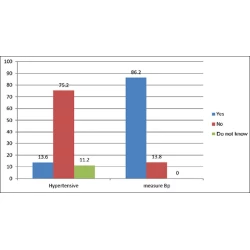
Background: The Dietary Approaches to Stop Hypertension (DASH) diet lowers blood pressure (BP) effectively. There is evidence that strongly supports the concept that lifestyle modification has a powerful effect on BP. The DASH diet includes increased physical activity, reduced salt intake, weight loss, increased potassium intake, and an overall healthy dietary pattern. This study assesses the knowledge and attitudes of Saudis in Riyadh City towards lifestyle and hypertension. Methods: A cross-sectional study was designed using a questionnaire-based assessment tool, which included sociodemographic data, knowledge and lifestyle attitudes toward hypertension, such as dietary factors, stress, smoking, physical activities, and diet-related diseases (including obesity and diabetes mellitus). Statistical analyses to examine the perceived association between lifestyle factors and hypertension risks included frequency distribution, percentages, and chi-square tests of significance. Results: Out of 934 total participants, 13.6% were hypertensive; 84.4% and 60.2% of participants believed eating salty food and fatty food, respectively, were risk factors for hypertension. Almost 66.0% of participants considered stress as a risk factor for the development of hypertension, whereas 77.0% considered smoking as a risk factor. The data showed that 87.5% considered obesity as a risk factor, and 73.8% considered reducing weight as a preventive measure for hypertension. Also, 68.8% believed that physical inactivity was a risk factor for hypertension. Data showed that 16.6 % ate vegetables and 23.1% ate fruits as recommended, whereas 18.8% and 18.4%, respectively, rarely ate vegetables and fruits. About 12.1% smoked and 19.7% exercised regularly, whereas 15.6% did not exercise at all. Traffic and examination were reported as stress factors by younger participants. Conclusion and Implications for Translation:The knowledge of the relationship between hypertension risk factors and eating salty or fatty food was high. In contrast, knowledge of not eating vegetables and fruits as a risk factor for the development of hypertension was very low among the Saudis.
Downloads
Similar Articles
- Elijah K Martin, Lea Jacobson, Gopal K Singh, Payam Sheikhatari, Mehrete Girmay, Smoking-Free Policies and Smoking Behaviors among Historically Black Colleges and Universities Students in the United States , Vol. 4 No. 2 (2020): The International Journal of Translational Medical Research and Public Health (IJTMRPH)
- Deogratias Ndagijimana, Connie Mureithi, Nicholas Njau Ngomi, Quality and Safety Management of Health Care Service Delivery among Public Hospitals in Rwanda: a Cross-Sectional Survey , Vol. 3 No. 2 (2019): The International Journal of Translational Medical Research and Public Health (IJTMRPH)
- Selina Khatun, Rafiqul Islam, Nazrul Islam Mondal, Nazrul Hoque, Clyde McNeil, Fatema Siddiqua, Sociodemographic Determinants of Early, Normal, and Delayed Menarche among Female College-Aged Students in Bangladesh , Vol. 1 No. 1 (2017): The International Journal of Translational Medical Research and Public Health (IJTMRPH)
- John A Markson, Early Infant Diagnosis of HIV in Primary Health Care Centers , Vol. 5 No. 1 (2021): The International Journal of Translational Medical Research and Public Health (IJTMRPH)
- Lind Grant-Oyeye, Full Range Leadership Approach: An Actionable Framework for Developing Resilient Public Health Leaders , Vol. 8 No. Continuous (2024): The International Journal of Translational Medical Research and Public Health (IJTMRPH)
- Omar M Young, Jackyln C Fuller, Henry W Lewis III, An Innovative Approach to E-mentorship for Black Applicants to Graduate Medical Education (GME) Programs , Vol. 8 No. Continuous (2024): The International Journal of Translational Medical Research and Public Health (IJTMRPH)
- Gregory Pappas, Introduction to Special Collection: Building the Real-World Evidence Infrastructure to Accelerate Innovation and Improve Outcomes in Healthcare , Vol. 9 No. Special Collection (2025): The International Journal of Translational Medical Research and Public Health (IJTMRPH)
- Bright Opoku Ahinkorah, Edward Kwabena Ameyaw, Abdul-Aziz Seidu, Sanni Yaya, Predictors of Female Genital Mutilation or Cutting Among Daughters of Women in Guinea, West Africa , Vol. 5 No. 1 (2021): The International Journal of Translational Medical Research and Public Health (IJTMRPH)
- Vinod K Ramani, Radheshyam Naik, A Narrative Review of the Pathophysiology of Mucormycosis Infection Among COVID-19 Patients in India: Epidemiology and Clinical Implications , Vol. 6 No. 1 (2022): The International Journal of Translational Medical Research and Public Health (IJTMRPH)
- Lauren E Gibson, Albert Adusei Dua, Jake W Coldiron, Amanda S Peters, Sushana Lamsal, Grace-Elizabeth A Edeh, Destiny Masha, Elizabeth A Armstrong-Mensah, Individual and Community Level Factors Related to Contraceptive Access, Family Planning, and Reproductive Health Challenges Among Women in Kumasi, Ghana: A Field Study , Vol. 6 No. 1 (2022): The International Journal of Translational Medical Research and Public Health (IJTMRPH)
<< < 2 3 4 5 6 7 8 9 10 11 > >>
You may also start an advanced similarity search for this article.
Published
How to Cite
Issue
Section
License
Copyright © 2020 Bushra Elbashir, Msab Al-dkheel, Hamad Aldakheel, Naif Aruwished, Nasser Alodayani. Published by Global Health and Education Projects, Inc., USA.

This is an open-access article distributed under the terms of the Creative Commons Attribution-NonCommercial-ShareAlike 4.0 International License , which permits others to remix, transform, and build upon the work non-commercially, provided the original author is credited and the new creations are licensed under the same terms.



 .
.

