
Sexually Transmitted Infections in Pre-Exposure Prophylaxis Patients
DOI:
https://doi.org/10.21106/ijtmrph.461Keywords:
- HIV,
- Men who have Sex with Men (MSM),
- Pre-exposure Prophylaxis (PrEP),
- STI
Abstract
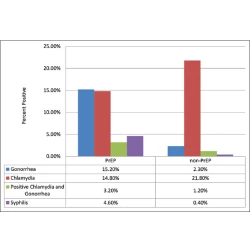
Background and Objective: Pre-exposure prophylaxis (PrEP) effectively prevents the spread of the human immunodeficiency virus (HIV). HIV is a disease primarily contracted by men who have sex with men or the sharing of needles, syringes, and other drug injection equipment. However, there are some disparities over the thought that PrEP patients have a disproportionate incidence of sexually transmitted infections (STIs) compared with non-PrEP patients. This study aims to clarify the disparity and identify if PrEP patients have a higher incidence of STIs. Methods: A survey of 143 respondents was conducted on STI incidence, risk factors, and abstinence from May 13, 2022, to June 20, 2022. The results were analyzed in Statistical Package for the Social Sciences (SPSS V28.0.0.0). SPSS was used to analyze the descriptive statistics associated with STI data obtained from the Naval Medical Readiness and Training Command, Camp Lejeune, Community Health Clinic Patient and Laboratory Tracker. Results: This study found a higher incidence of STIs among PrEP patients than non-PrEP patients and a statistical significance (p = 0.010) between the number of partners a person had sex with over the past year and the lifetime incidence of STIs. Portions of the data in the linear regression were used to calculate the significance and can be used as a predictor of STIs based on the number of partners a person has. This can help patients within this community understand their actual risk of contracting an STI based on a potential risk factor. Conclusion and Implications for Translation: This study found a higher incidence of STIs among PrEP patients than non-PrEP patients. Additionally, the study can help public health professionals understand the risks associated with military patients who take PrEP and target specific risk factors that influence the disparity in the incidence of STIs. Future studies may use survey data from this study to understand the implications of other risk factors and their association with STIs. Public health professionals can also use these data to develop a predictive index for many risk factors. A predictive index on STI risk is an extremely valuable tool as it allows users to view their risk of obtaining an STI.
Downloads
Similar Articles
- Musa M Dogara, Saadatu Ahmad, Babalola J Balogun, Salwa S Dawaki, Muzammil B Mustapha, Aminu U Abdurrahman, Lawal Bala, Abubakar Zakari, David U Livingstone, Schistosomiasis and Associated Risk Factors Among School-Aged Children in Northern Nigeria , Vol. 4 No. 2 (2020): The International Journal of Translational Medical Research and Public Health (IJTMRPH)
- Nsofwa Jubedah Mwansa, Victor Daka, David Mulenga, Ruth L Mfune, Bright Mukanga, Christopher Nyirenda, Seter Siziya, Correlates of Seizure Control Among Patients with Epilepsy at Two Referral Hospitals in Zambia , Vol. 4 No. 2 (2020): The International Journal of Translational Medical Research and Public Health (IJTMRPH)
- Caroline Okeke, Evangeline T Oparaocha, Book of Abstracts: 3rd International Congress on Health Sciences and Technology, School of Health Technology, Federal University of Technology Owerri, Nigeria, 8-11 August, 2018 , Vol. 2 No. S1 (2018): The International Journal of Translational Medical Research and Public Health (IJTMRPH)
- Laila Al Afnan, Insights into Smoking Behaviors among University Students in Jordan: A Narrative Review , Vol. 9 No. Continuous (2025): The International Journal of Translational Medical Research and Public Health (IJTMRPH)
- Uksim Qadri, Bashir Ahmad Fomda, Saleem Javaid Wani, Shugufta Roohi, Sanam Rasool Wani, Hepatitis A and E: Prevalence, Epidemiology and Co-infection among Patients with Acute Viral Hepatitis , Vol. 9 No. Continuous (2025): The International Journal of Translational Medical Research and Public Health (IJTMRPH)
- Gopal K. Singh, Hyunjung Lee, Romuladus E. Azuine, Trends and Socioeconomic, Demographic, and Behavioral Determinants of Kidney Disease Prevalence among African Americans in the United States, 1997–2021 , Vol. 9 No. Continuous (2025): The International Journal of Translational Medical Research and Public Health (IJTMRPH)
- Abhijit Dey, Rajat Basu, Poulami Basu, Simran Keshri, Bandita Sengupta, Sandip Roy, Prevention Versus Treatment: Barriers to Tuberculosis Prevention and Treatment in Urban Areas , Vol. 9 No. Continuous (2025): The International Journal of Translational Medical Research and Public Health (IJTMRPH)
- Ariel Braverman, Integrating Human Factors in the Healthcare System: Embracing Aviation Methodologies and Artificial Intelligence (AI) to Enhance Provider Performance and Patient Safety , Vol. 8 No. Continuous (2024): The International Journal of Translational Medical Research and Public Health (IJTMRPH)
- Anushka Banerjee, Abhijit G. Banerjee, Chronic Inflammation in Polycystic Ovarian Syndrome: Examining Biomarker–Driven Control Strategies to Reduce Population–Level Disease Burden , Vol. 8 No. Continuous (2024): The International Journal of Translational Medical Research and Public Health (IJTMRPH)
- Elizabeth Armstrong Mensah, Maria Adjini, Bria Pringle-Weston, Akwasi Akosah, Rachael Addo, Late Dementia Diagnosis Among Elderly Minority Populations in the United States: Causes, Effects, and Addressing Inequities , Vol. 8 No. Continuous (2024): The International Journal of Translational Medical Research and Public Health (IJTMRPH)
You may also start an advanced similarity search for this article.
Published
How to Cite
Issue
Section
License
Copyright © 2023 Nicholas A Sleeman, Carol Hoban, Samer Koutoubi. Published by Global Health and Education Projects, Inc., USA.

This is an open-access article distributed under the terms of the Creative Commons Attribution-NonCommercial-ShareAlike 4.0 International License , which permits others to remix, transform, and build upon the work non-commercially, provided the original author is credited and the new creations are licensed under the same terms.



 .
.

