
Sexually Transmitted Infections in Pre-Exposure Prophylaxis Patients
DOI:
https://doi.org/10.21106/ijtmrph.461Keywords:
- HIV,
- Men who have Sex with Men (MSM),
- Pre-exposure Prophylaxis (PrEP),
- STI
Abstract
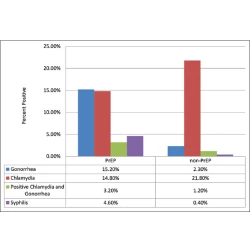
Background and Objective: Pre-exposure prophylaxis (PrEP) effectively prevents the spread of the human immunodeficiency virus (HIV). HIV is a disease primarily contracted by men who have sex with men or the sharing of needles, syringes, and other drug injection equipment. However, there are some disparities over the thought that PrEP patients have a disproportionate incidence of sexually transmitted infections (STIs) compared with non-PrEP patients. This study aims to clarify the disparity and identify if PrEP patients have a higher incidence of STIs. Methods: A survey of 143 respondents was conducted on STI incidence, risk factors, and abstinence from May 13, 2022, to June 20, 2022. The results were analyzed in Statistical Package for the Social Sciences (SPSS V28.0.0.0). SPSS was used to analyze the descriptive statistics associated with STI data obtained from the Naval Medical Readiness and Training Command, Camp Lejeune, Community Health Clinic Patient and Laboratory Tracker. Results: This study found a higher incidence of STIs among PrEP patients than non-PrEP patients and a statistical significance (p = 0.010) between the number of partners a person had sex with over the past year and the lifetime incidence of STIs. Portions of the data in the linear regression were used to calculate the significance and can be used as a predictor of STIs based on the number of partners a person has. This can help patients within this community understand their actual risk of contracting an STI based on a potential risk factor. Conclusion and Implications for Translation: This study found a higher incidence of STIs among PrEP patients than non-PrEP patients. Additionally, the study can help public health professionals understand the risks associated with military patients who take PrEP and target specific risk factors that influence the disparity in the incidence of STIs. Future studies may use survey data from this study to understand the implications of other risk factors and their association with STIs. Public health professionals can also use these data to develop a predictive index for many risk factors. A predictive index on STI risk is an extremely valuable tool as it allows users to view their risk of obtaining an STI.
Downloads
Similar Articles
- Ashok Bahadur Varma, Can the Internal Nasal Valves Method Be a Game Changer for Preventing Respiratory Tract Infections? , Vol. 8 No. Continuous (2024): The International Journal of Translational Medical Research and Public Health (IJTMRPH)
- Bashir Faiza, Hassan Mehmood, Sumera Naz, Saima Naz, Prevalence and Determinants of Substance Abuse Among Slum Dwellers in Islamabad- Pakistan , Vol. 3 No. 2 (2019): The International Journal of Translational Medical Research and Public Health (IJTMRPH)
- Hyunjung Lee, Gopal K Singh, Estimating Contributions of Social and Behavioral Factors to Cardiovascular Disease, Cancer, COPD, and Unintentional-Injury Mortality Disparities by Psychological Distress in the United States: A Blinder-Oaxaca Decomposition Analysis of the 1997-2014 NHIS , Vol. 5 No. 2 (2021): The International Journal of Translational Medical Research and Public Health (IJTMRPH)
- Lauren E Gibson, Albert Adusei Dua, Jake W Coldiron, Amanda S Peters, Sushana Lamsal, Grace-Elizabeth A Edeh, Destiny Masha, Elizabeth A Armstrong-Mensah, Individual and Community Level Factors Related to Contraceptive Access, Family Planning, and Reproductive Health Challenges Among Women in Kumasi, Ghana: A Field Study , Vol. 6 No. 1 (2022): The International Journal of Translational Medical Research and Public Health (IJTMRPH)
- Betregiorgis Zegeye, Nicholas Kofi Adjei, Bright Opoku Ahinkorah, Edward Kwabena Ameyaw, Eugene Budu, Abdul-Aziz Seidu, Dina Idriss-Wheeler, Sanni Yaya, Barriers and Facilitators to Accessing Health Care Services among Married Women in Ethiopia: a Multi-level Analysis of the Ethiopia Demographic and Health Survey , Vol. 5 No. 2 (2021): The International Journal of Translational Medical Research and Public Health (IJTMRPH)
- Sara F Khan, Deepa Dongarwar, Hamisu M Salihu, Intimate Partner Violence Among Adolescent Latina Mothers and Their Reproductive Outcomes: A Systematic Review , Vol. 6 No. 2 (2022): The International Journal of Translational Medical Research and Public Health (IJTMRPH)
- Gopal K. Singh, Lyoung Hee Kim, Hyunjung Lee, Romuladus E Azuine, Disparities in Prevalence of COVID-19, Long COVID, Disease Severity, and Mental Health Outcomes among US Adults by Industrial Sector of Employment, September-November 2022 , Vol. 7 No. 2 (2023): The International Journal of Translational Medical Research and Public Health (IJTMRPH)
- Fazal Dad, Tafara Ndumiyana, Aweke Kebede, Blessing Butaumocho, Anthony Muganza, Robert Ackatia Armah, Lidya Mitike, Mella Taban, Strengthening Rural Food Systems through the UN World Food Program’s Fresh Food Voucher in Ethiopia’s Somali Region: An Evaluation of Nutritional and Market Impacts , Vol. 10 (2026): The International Journal of Translational Medical Research and Public Health (IJTMRPH)
- Anna Kallasidou, Konstantinos Giannakou, Costas A. Christophi, Maria Kyprianidou, Association between Components of Metabolic Syndrome and Rheumatic, Cardiovascular, Gastrointestinal, and Chronic Kidney Disease: A Cross-Sectional Study of Adults in Cyprus , Vol. 9 No. Continuous (2025): The International Journal of Translational Medical Research and Public Health (IJTMRPH)
- Peter Chilipweli, Given Mwambope, Abubakar O. Abdallah, Patrick Mwakubo, Aneth Dunia, Compliance, Barriers, and Enhancers of WHO “Five Moments for Hand Hygiene” Among Healthcare Workers in Tanzania , Vol. 9 No. Continuous (2025): The International Journal of Translational Medical Research and Public Health (IJTMRPH)
<< < 1 2 3 4 5 6 7 8 9 10 > >>
You may also start an advanced similarity search for this article.
Published
How to Cite
Issue
Section
License
Copyright © 2023 Nicholas A Sleeman, Carol Hoban, Samer Koutoubi. Published by Global Health and Education Projects, Inc., USA.

This is an open-access article distributed under the terms of the Creative Commons Attribution-NonCommercial-ShareAlike 4.0 International License , which permits others to remix, transform, and build upon the work non-commercially, provided the original author is credited and the new creations are licensed under the same terms.



 .
.

