
Sexually Transmitted Infections in Pre-Exposure Prophylaxis Patients
DOI:
https://doi.org/10.21106/ijtmrph.461Keywords:
- HIV,
- Men who have Sex with Men (MSM),
- Pre-exposure Prophylaxis (PrEP),
- STI
Abstract
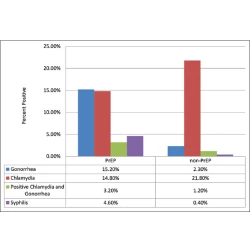
Background and Objective: Pre-exposure prophylaxis (PrEP) effectively prevents the spread of the human immunodeficiency virus (HIV). HIV is a disease primarily contracted by men who have sex with men or the sharing of needles, syringes, and other drug injection equipment. However, there are some disparities over the thought that PrEP patients have a disproportionate incidence of sexually transmitted infections (STIs) compared with non-PrEP patients. This study aims to clarify the disparity and identify if PrEP patients have a higher incidence of STIs. Methods: A survey of 143 respondents was conducted on STI incidence, risk factors, and abstinence from May 13, 2022, to June 20, 2022. The results were analyzed in Statistical Package for the Social Sciences (SPSS V28.0.0.0). SPSS was used to analyze the descriptive statistics associated with STI data obtained from the Naval Medical Readiness and Training Command, Camp Lejeune, Community Health Clinic Patient and Laboratory Tracker. Results: This study found a higher incidence of STIs among PrEP patients than non-PrEP patients and a statistical significance (p = 0.010) between the number of partners a person had sex with over the past year and the lifetime incidence of STIs. Portions of the data in the linear regression were used to calculate the significance and can be used as a predictor of STIs based on the number of partners a person has. This can help patients within this community understand their actual risk of contracting an STI based on a potential risk factor. Conclusion and Implications for Translation: This study found a higher incidence of STIs among PrEP patients than non-PrEP patients. Additionally, the study can help public health professionals understand the risks associated with military patients who take PrEP and target specific risk factors that influence the disparity in the incidence of STIs. Future studies may use survey data from this study to understand the implications of other risk factors and their association with STIs. Public health professionals can also use these data to develop a predictive index for many risk factors. A predictive index on STI risk is an extremely valuable tool as it allows users to view their risk of obtaining an STI.
Downloads
Similar Articles
- Peter Chilipweli, Given Mwambope, Abubakar O. Abdallah, Patrick Mwakubo, Aneth Dunia, Compliance, Barriers, and Enhancers of WHO “Five Moments for Hand Hygiene” Among Healthcare Workers in Tanzania , Vol. 9 No. Continuous (2025): The International Journal of Translational Medical Research and Public Health (IJTMRPH)
- Amina A. Umar, Yusuf D. Jobbi, Hassan Adam Murtala, Aisha Adam Abdullahi, Muktar H. Aliyu, Sani H. Aliyu, Eknath Naik, Ololade D. Adeyemi, Deepa Dongarwar, Hamisu M. Salihu, Socioeconomic and Clinical Determinants of Nutritional Phenotypes among Children with Sickle Cell Disease , Vol. 9 No. Continuous (2025): The International Journal of Translational Medical Research and Public Health (IJTMRPH)
- Sergio Navarro, Kelsey Stewart, Katelyn M Tessier, Aemon Berhane, Susana Prestinary Alvarado, Tavonga Tafirei, Hodan Abdi, Evan J Keil, Todd Tuttle, Jennifer Rickard, Medical Students’ Perceptions of Clinical and Research Training: An International Needs Assessment of 26 Countries , Vol. 7 No. 2 (2023): The International Journal of Translational Medical Research and Public Health (IJTMRPH)
- Sorochi Iloanusi, Osaro Mgbere, Nchebe-Jah R Iloanusi, Ismaeel Yunusa, Ekere J Essien, COVID-19 Related Misconceptions and Prevention Practices Among Residents of a Populous Commercial City in Nigeria , Vol. 5 No. 2 (2021): The International Journal of Translational Medical Research and Public Health (IJTMRPH)
- Hyunjung Lee, Gopal K Singh, Marked Disparities in Cardiovascular Disease Mortality by Levels of Happiness and Life Satisfaction in the United States , Vol. 4 No. 2 (2020): The International Journal of Translational Medical Research and Public Health (IJTMRPH)
- Hyunjung Lee, Gopal K Singh, Association of Happiness and Life Satisfaction with Cancer Mortality in the United States: A Longitudinal Analysis , Vol. 4 No. 2 (2020): The International Journal of Translational Medical Research and Public Health (IJTMRPH)
- Elizabeth Armstrong-Mensah, Ato Kwamena Tetteh, Gifty Rhodalyn Tetteh, COVID-19 Pandemic: Face Mask Mandates, Hospitalization, and Infection Rates in the United States , Vol. 5 No. 2 (2021): The International Journal of Translational Medical Research and Public Health (IJTMRPH)
- Moses M Gitonga, Kenneth K Ngure, Elizabeth E Echoka, Effectiveness of a Community Level Maternal Health Intervention in Improving Uptake of Postnatal Care in Migori County, Kenya , Vol. 3 No. 1 (2019): The International Journal of Translational Medical Research and Public Health (IJTMRPH)
- Nasir Ilyas, Romuladus E Azuine, Alina Tamiz, COVID-19 Pandemic in Pakistan , Vol. 4 No. 1 (2020): The International Journal of Translational Medical Research and Public Health (IJTMRPH)
- Shivam Singh, Ashok Sharma, Richa Tripathi, Vitthal Govindappa Huddar, Subhash Gupta, Network Pharmacology and Preliminary in Vitro Evaluation of Piper longum (Indian Long Pepper) in Breast Cancer , Vol. 10 (2026): The International Journal of Translational Medical Research and Public Health (IJTMRPH)
<< < 2 3 4 5 6 7 8 9 10 11 > >>
You may also start an advanced similarity search for this article.
Published
How to Cite
Issue
Section
License
Copyright © 2023 Nicholas A Sleeman, Carol Hoban, Samer Koutoubi. Published by Global Health and Education Projects, Inc., USA.

This is an open-access article distributed under the terms of the Creative Commons Attribution-NonCommercial-ShareAlike 4.0 International License , which permits others to remix, transform, and build upon the work non-commercially, provided the original author is credited and the new creations are licensed under the same terms.



 .
.

