
Sexually Transmitted Infections in Pre-Exposure Prophylaxis Patients
DOI:
https://doi.org/10.21106/ijtmrph.461Keywords:
- HIV,
- Men who have Sex with Men (MSM),
- Pre-exposure Prophylaxis (PrEP),
- STI
Abstract
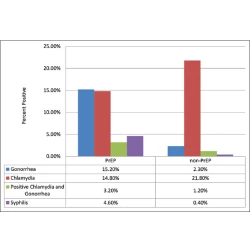
Background and Objective: Pre-exposure prophylaxis (PrEP) effectively prevents the spread of the human immunodeficiency virus (HIV). HIV is a disease primarily contracted by men who have sex with men or the sharing of needles, syringes, and other drug injection equipment. However, there are some disparities over the thought that PrEP patients have a disproportionate incidence of sexually transmitted infections (STIs) compared with non-PrEP patients. This study aims to clarify the disparity and identify if PrEP patients have a higher incidence of STIs. Methods: A survey of 143 respondents was conducted on STI incidence, risk factors, and abstinence from May 13, 2022, to June 20, 2022. The results were analyzed in Statistical Package for the Social Sciences (SPSS V28.0.0.0). SPSS was used to analyze the descriptive statistics associated with STI data obtained from the Naval Medical Readiness and Training Command, Camp Lejeune, Community Health Clinic Patient and Laboratory Tracker. Results: This study found a higher incidence of STIs among PrEP patients than non-PrEP patients and a statistical significance (p = 0.010) between the number of partners a person had sex with over the past year and the lifetime incidence of STIs. Portions of the data in the linear regression were used to calculate the significance and can be used as a predictor of STIs based on the number of partners a person has. This can help patients within this community understand their actual risk of contracting an STI based on a potential risk factor. Conclusion and Implications for Translation: This study found a higher incidence of STIs among PrEP patients than non-PrEP patients. Additionally, the study can help public health professionals understand the risks associated with military patients who take PrEP and target specific risk factors that influence the disparity in the incidence of STIs. Future studies may use survey data from this study to understand the implications of other risk factors and their association with STIs. Public health professionals can also use these data to develop a predictive index for many risk factors. A predictive index on STI risk is an extremely valuable tool as it allows users to view their risk of obtaining an STI.
Downloads
Similar Articles
- Patricia Mutale, Mwenya Kwangu, Chishala Mirriam Kapambwe Muchemwa, Moono Silitongo, Mutale Chileshe, Knowledge and Preconception Care Seeking Practices among Reproductive-age Diabetic Women in Zambia , Vol. 1 No. 2 (2017): The International Journal of Translational Medical Research and Public Health (IJTMRPH)
- Vinod K Ramani, Radheshyam Naik, A Narrative Review of the Pathophysiology of Mucormycosis Infection Among COVID-19 Patients in India: Epidemiology and Clinical Implications , Vol. 6 No. 1 (2022): The International Journal of Translational Medical Research and Public Health (IJTMRPH)
- Anagha Lokhande, Improving Reproductive and Maternal Healthcare Uptake in India: An Evaluation of Project Ujjwal Public-Private Partnership Program , Vol. 7 No. 2 (2023): The International Journal of Translational Medical Research and Public Health (IJTMRPH)
- Comfort Z Olorunsaiye, Hannah M Degge, Jiana Saigh, Association Between Source of Treatment and Quality of Childhood Diarrhea Management Among Under-Five Children in Nigeria , Vol. 5 No. 2 (2021): The International Journal of Translational Medical Research and Public Health (IJTMRPH)
- Lucrèce M Delicat-Loembet, A.D. Nno Mabiala, Ulrich Bisvigou, Eveline Avoune, Solange Bongo, André N’Tchoreret, Arnaud Kouoyo, Alain Ondo, Alexis E Dokekias, Jean Koko, Simon Ategbo, Diagnosis of Sickle Cell Disease in Gabon Using Sickle SCAN®: A Point-of-Care Blood Test , Vol. 6 No. 2 (2022): The International Journal of Translational Medical Research and Public Health (IJTMRPH)
- Linxi Liu, Kelly Thevenet-Morrison, Peter Viazie, Hugh F Crean, Christopher L Seplaki, Ann Dozier, Amina Alio, Maternal History of Adverse Childhood Experiences and Subsequent Infant Paternal Involvement , Vol. 8 No. Continuous (2024): The International Journal of Translational Medical Research and Public Health (IJTMRPH)
- Gonzalo Monge, Matías Otto-Yáñez, Nicole Norambuena, Verónica Martínez, Daniela Retamales, Rodrigo Torres-Castro, Safety of Hyperbaric Oxygenation Treatment and Evaluation of Associated Clinical Parameters: A Single-Institutional Prospective Cohort Study , Vol. 7 No. 1 (2023): The International Journal of Translational Medical Research and Public Health (IJTMRPH)
- Johnny Rice II, Mercy N. Shenge, Environmental Justice and Environmental Crime Awareness at Historically Black Colleges and Universities (HBCUs): Insights from Behavioral Science Researchers , Vol. 10 (2026): The International Journal of Translational Medical Research and Public Health (IJTMRPH)
- Elizabeth Armstrong-Mensah , Niha Mitha, Aireona McNair, The Mental Health of Syrian Refugees in the United States: Examining Critical Risk Factors and Major Barriers to Mental Health Care Access , Vol. 7 No. 1 (2023): The International Journal of Translational Medical Research and Public Health (IJTMRPH)
- Elisa J. Gordon, Zubairu Iliyasu, Elizabeth S. Rose, Fatimah I. Tsiga-Ahmed, Usman J. Wudil, Aishatu L. Adamu, C. William Wester, Muktar H. Aliyu, Building Capacity for the Ethical Conduct of Genetic and Genomic Research in Nigeria: The Vanderbilt-Nigeria Research Ethics Training Program , Vol. 9 No. Continuous (2025): The International Journal of Translational Medical Research and Public Health (IJTMRPH)
<< < 1 2 3 4 5 6 7 8 9 10 > >>
You may also start an advanced similarity search for this article.
Published
How to Cite
Issue
Section
License
Copyright © 2023 Nicholas A Sleeman, Carol Hoban, Samer Koutoubi. Published by Global Health and Education Projects, Inc., USA.

This is an open-access article distributed under the terms of the Creative Commons Attribution-NonCommercial-ShareAlike 4.0 International License , which permits others to remix, transform, and build upon the work non-commercially, provided the original author is credited and the new creations are licensed under the same terms.



 .
.

